
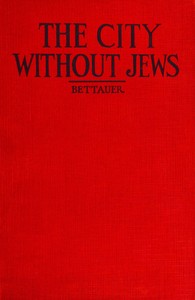
The city without Jews : A novel of our time by Hugo Bettauer
Published in 1922, Hugo Bettauer's novel is a piece of speculative fiction that feels painfully relevant. It's not a complex fantasy; it's a straightforward, almost clinical look at a society's self-inflicted wound.
The Story
The story is set in a thinly-disguised version of Vienna. A new political movement, the 'Christian Social Party,' wins power. Led by a demagogue, they blame all of Austria's economic and social woes on its Jewish population. They pass a law—the 'Jew Removal Act'—and within months, every Jewish person is forced to leave. At first, there's public jubilation. Jobs and apartments seem to open up. But the victory is hollow. The city's vibrant cultural scene collapses without its Jewish artists and thinkers. Key industries, from medicine to law to entertainment, grind to a halt because the skilled people who ran them are gone. The economy nosedives. What was supposed to be a utopia becomes a dull, impoverished, and anxious place. The novel follows a few characters, including a politician who helped create the law and a young non-Jewish man in love with a Jewish woman, as they witness their city unravel.
Why You Should Read It
This book hit me hard because it's not really about the people who were expelled. It's about the society that did the expelling. Bettauer shows, step by logical step, how a city can convince itself that cutting out a part of itself is a good idea, and then the shock of the consequences. The characters aren't deeply psychological portraits; they're representatives of a public mood that swings from hateful arrogance to regretful panic. Reading it in the 21st century, you can't help but see parallels in how groups are still scapegoated today. It's a masterclass in showing how interconnected a community truly is, and how hatred ultimately makes everyone poorer.
Final Verdict
This is a must-read for anyone interested in history, politics, or just powerful stories about society. It's perfect for book clubs because it will spark intense discussion. It's also surprisingly accessible—it reads quickly and clearly. Be warned: it's not a feel-good book. It's a stark, sobering look in the mirror. But in its simplicity lies its enduring power. Bettauer saw a dark future on the horizon in 1922, and his fictional warning is one we should still be listening to.
This title is part of the public domain archive. It serves as a testament to our shared literary heritage.
Mark Rodriguez
2 years agoIf you enjoy this genre, the flow of the text seems very fluid. Worth every second.
Jennifer Torres
3 months agoI had low expectations initially, however the emotional weight of the story is balanced perfectly. Highly recommended.
Amanda White
1 year agoThe layout is very easy on the eyes.






Paul Rodriguez
11 months agoComprehensive and well-researched.