
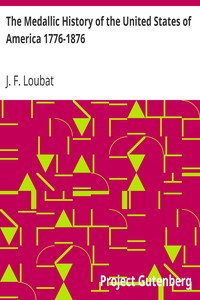
The Medallic History of the United States of America 1776-1876 by J. F. Loubat
Okay, let's clear something up first. This isn't a novel with a plot. There's no main character named John Medallion. Instead, the 'story' is the first century of the United States, told through the official medals the government created. Author J.F. Loubat acted as a collector and historian, gathering these often-overlooked artifacts and presenting them in order.
The Story
The book starts in 1776 with medals awarded by the Continental Congress for military bravery, like the one given to George Washington after the British left Boston. It then moves forward year by year. You see medals for major events: the end of the Revolutionary War, the Louisiana Purchase, the War of 1812, and the expansion westward. It includes peace medals given to Native American leaders (which have their own deeply complex history), medals for scientific achievements like the telegraph, and commemorations for everything from new statehood to the centennial in 1876. The narrative is the nation's growing pains and triumphs, captured in silver and bronze.
Why You Should Read It
What grabbed me was the weird intimacy of it. These medals were objects people held. A Shawnee chief might have worn a peace medal from the president while navigating impossible pressures. A soldier would have received a medal for valor and kept it for a lifetime. Loubat's work lets you see the official version of history—the one the young government wanted to cement in metal. Reading the descriptions next to the engraved images, you start asking questions about what was left out, what was simplified, and why certain moments were chosen for this permanent honor. It makes history feel less like a list of dates and more like a series of deliberate, tangible choices.
Final Verdict
This is a niche book, but a fascinating one. It's perfect for history buffs who are tired of the same old biographies and battle accounts. It's also great for anyone interested in art, design, or how societies use symbols to tell their story. You can dip in and out of it, looking up your favorite era. It's not a light read, but it's a uniquely rewarding one. Think of it as a museum exhibit you can browse from your couch, one that offers a silent, metallic commentary on how America saw itself while it was still figuring things out.
The copyright for this book has expired, making it public property. It is now common property for all to enjoy.
Brian King
1 year agoI stumbled upon this title and the narrative structure is incredibly compelling. This story will stay with me.
James Robinson
6 months agoHelped me clear up some confusion on the topic.
Deborah Ramirez
1 year agoThanks for the recommendation.
Elijah Hill
2 years agoSurprisingly enough, the atmosphere created is totally immersive. Definitely a 5-star read.




Matthew White
3 months agoInitially, I was looking for a specific answer, but the inclusion of diverse viewpoints strengthens the overall narrative. It’s a comprehensive resource that doesn't feel bloated.