1

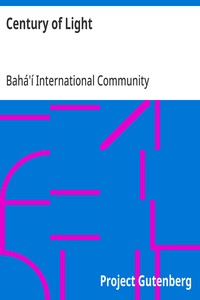
Century of Light — Inside the Classic
(0 User reviews)
886
Project Gutenberg
2006
Not confirmed
Bahai Faith -- History -- 20th century
Readers of public-domain and historical texts
Project Gutenberg digital edition
en
Edition facts
Words
56,293
Reading time
245 min
Text sections
10
For Century of Light — Inside the Classic, the stored edition analysis reports 56,293 words, 4 hr 5 min estimated reading time, and 10 detected text sections.
The text analysis averages about 31.1 words per sentence, while the detected sections provide another way to judge how the source is divided.
Project Gutenberg metadata also associates the work with “Bahai Faith -- History -- 20th century,” connecting these edition facts with the source record’s subject description.
Source:
Project Gutenberg record #19267
An institutional review of 20th-century Bahá'í history, examining the Faith's emergence alongside global upheavals through the lens of Bahá'í teachings, with precise diction and structured argumentation.
Editorial Edition Score
4.7/5
★★★★★
★★★★★
Calculated from edition completeness, EPUB availability, text structure and catalogue metadata. Not a user rating.
How this score is calculated
- Description quality20 pts
- Title & short description10 pts
- Source metadata20 pts
- Text length15 pts
- Chapters / structure15 pts
- EPUB file integrity20 pts
Total of 100 points, scaled to a 2.5-5.0 range. Editions with an empty description or a missing EPUB file are not scored.
Edition quality
Public-domain source text
Read the source text
The source text is kept in the dedicated reader, separate from this catalogue record and its commentary.
The opening pages of Century of Light frame the twentieth century as "the most turbulent in the history of the human race," a phrase that sets the tone for a work that pairs sweeping historical claims with careful institutional documentation. The text is authored by the Bahá'í International Community and supervised by the Universal House of Justice, lending it an official, collective voice rather than a personal one. The foreword establishes a dual focus: the profound changes of the past hundred years and the parallel emergence of the Bahá'í Cause from obscurity. This structural parallelism—contrasting worldly chaos with spiritual order—recurs throughout the excerpts, shaping both the argument and the rhythm of the prose.
The Voice of Institutional Authority
The text's diction consistently reflects its origin as a document prepared under institutional supervision. Phrases such as "prepared under our supervision" and "we commend it to the thoughtful study of the friends" employ a formal, collective first-person plural that avoids individual authorship. This voice is reinforced by frequent references to the Universal House of Justice and the Hands of the Cause, whose actions are described with precise verbs: "appointed," "designating," "charged." The prose maintains a measured, almost judicial tone, even when narrating crises like Shoghi Effendi's death, which is described as "devastating" but without emotional elaboration. This restraint suggests a deliberate choice to prioritize doctrinal continuity over personal grief.
Quotation as Structural Device
The excerpts embed quotations from authoritative sources—Bahá'u'lláh, the Will and Testament of 'Abdu'l-Bahá, and messages from Shoghi Effendi—as structural anchors. These are not merely illustrative but serve as proof texts that advance the narrative. For instance, the passage on the Universal House of Justice quotes Bahá'u'lláh's assurance that "God will verily inspire them with whatsoever He willeth," followed by 'Abdu'l-Bahá's elaboration on its authority. The quotations are introduced with formulaic phrases like "It is incumbent upon" and "Unto the Most Holy Book every one must turn," creating a layered textual authority. This technique allows the work to present itself as both a historical account and a theological exposition, where events are interpreted through scriptural lenses.
Temporal Framing and Narrative Rhythm
The narrative employs a distinctive temporal structure, moving between broad historical epochs and specific dates. The opening sentence declares the century's end, then immediately shifts to a present-tense assessment of humanity's desperation. Later passages use precise dates—3 June 1957, 4 November 1957, 21 April 1963—to anchor key events, creating a rhythm of crisis and resolution. The death of Shoghi Effendi is followed by the triumph of the Ten Year Crusade, a juxtaposition that underscores the work's theme of providential order emerging from apparent disaster. This alternating pattern of setback and achievement is reinforced by the use of asterisks to mark transitions, signaling shifts in tone or topic without explicit commentary.
Lexical Choices and Conceptual Pairings
The text repeatedly pairs contrasting concepts to frame its argument: "moral and social chaos" versus "unifying power," "obscurity" versus "global scale," "grief" versus "triumph." These pairings are not merely rhetorical but reflect a worldview in which worldly disorder is countered by spiritual order. The word "Covenant" appears capitalized, signaling its technical meaning within Bahá'í theology. Similarly, terms like "Administrative Order" and "Chief Stewards" are used without definition, assuming reader familiarity. The prose favors abstract nouns—"protection," "evolution," "coordination"—over concrete description, giving the text a conceptual density. This lexical register aligns with the work's purpose as a review for an informed audience, not a general introduction.
Readers approaching Century of Light should attend to how its institutional authorship shapes both content and style. The work does not aim for neutral historiography but for a providential interpretation of events, supported by carefully selected quotations and a formal, collective voice. Noticing the recurring structural patterns—the juxtaposition of crisis and triumph, the use of precise dates, the reliance on authoritative texts—will illuminate how the narrative constructs its argument. This is a document meant for study rather than casual reading, and its value lies in the coherence of its perspective.
There are no reviews for this eBook.
There are no comments for this eBook.
Reader reflection
Your personal reading reflection
Build a private reading journal entry for this title.
Your progress
0
/
10
2
How much did you enjoy the reading experience?
3
Would you encourage someone else to read it?
4
Did the language feel accessible?
5
Did the book meet your expectations?
6
How clearly were the main ideas presented?
7
How would you describe its reading pace?
8
How useful were the ideas in this book?
9
What changed or sharpened your thinking?
10