1

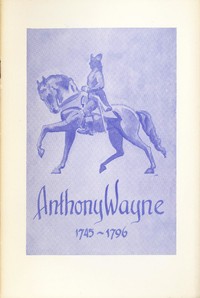
Anthony Wayne, 1745-1796 — Key Ideas to Explore
(0 User reviews)
1508
Project Gutenberg
2021
Not confirmed
United States -- History -- Revolution, 1775-1783 -- Biography; Wayne, Anthony, 1745-1796
Readers of public-domain and historical texts
Project Gutenberg digital edition
en
Edition facts
Words
5,109
Reading time
23 min
Text sections
1
The source record for Anthony Wayne, 1745-1796 — Key Ideas to Explore measures this digital text at 5,109 words, 23 min estimated reading time, and 1 detected text section.
The text analysis averages about 22.3 words per sentence, while the detected sections provide another way to judge how the source is divided.
Project Gutenberg metadata also associates the work with “United States -- History -- Revolution, 1775-1783 -- Biography,” connecting these edition facts with the source record’s subject description.
Source:
Project Gutenberg record #65397
A concise biography of Anthony Wayne, focusing on his military campaigns in the Old Northwest Territory, including the Battle of Fallen Timbers and the founding of Fort Wayne, based on a 1936 Dictionary of American Biography entry.
Editorial Edition Score
4.4/5
★★★★★
★★★★★
Calculated from edition completeness, EPUB availability, text structure and catalogue metadata. Not a user rating.
How this score is calculated
- Description quality20 pts
- Title & short description10 pts
- Source metadata20 pts
- Text length15 pts
- Chapters / structure15 pts
- EPUB file integrity20 pts
Total of 100 points, scaled to a 2.5-5.0 range. Editions with an empty description or a missing EPUB file are not scored.
Edition quality
Public-domain source text
Read the source text
The source text is kept in the dedicated reader, separate from this catalogue record and its commentary.
The biography opens with a foreword that frames Anthony Wayne’s campaign as a pivotal response to the defeats of Harmar and St. Clair, immediately establishing the stakes: if Wayne had failed, settlement in the region might have been “indefinitely delayed.” This sets a tone of historical contingency rather than inevitability. The text then shifts to Wayne’s early life, noting his preference for “feats of mock warfare” over classroom subjects, a detail that foreshadows his later military career. The structure moves briskly from family origins to his education as a surveyor, using concrete facts—500 acres, a tannery, a private academy—to anchor the narrative in specific places and trades.
From Mock Warfare to Surveying
The biography’s first section traces Wayne’s youth through a series of precise, place-based details. Born at Waynesboro, Pennsylvania, he was the only son of Isaac and Elizabeth Wayne, with an English ancestry that arrived via Ireland around 1724. The family’s 500-acre estate and tannery root the narrative in agrarian commerce. At sixteen, Wayne attended a private academy run by his uncle Gilbert Wayne in Philadelphia, where he was “more proficient in feats of mock warfare” than in academics—a phrase that subtly links his childhood play to the Indian wars then ongoing. The text notes he learned enough mathematics to qualify as a surveyor, a practical skill that would later serve him in mapping military terrain. These early details are not merely biographical filler; they establish a pattern of movement between settled farm life and frontier conflict, a tension that defines his career.
The Campaign and Its Turning Point
The foreword provides the clearest structural arc: after Harmar and St. Clair’s defeats, President Washington appointed Wayne to reorganize forces, subdue the Indians, and protect frontier settlements. The narrative culminates in the Battle of Fallen Timbers on August 20, 1794, described as a “decisive victory.” From there, Wayne marched westward to the headwaters of the Maumee River, where the junction of the St. Mary’s and St. Joseph rivers provided a commanding position. A fort was constructed and named Fort Wayne in his honor. The text emphasizes the strategic logic of this movement—choosing ground that “commands the adjacent area”—rather than offering dramatic battle scenes. The sequence of defeat, appointment, victory, and fort-building gives the biography a clear cause-and-effect structure, though the battle itself receives only a single sentence.
Sources and Their Limits
The biography is explicitly a reprint of Randolph C. Downes’s entry in the 1936 Dictionary of American Biography, volume nineteen, reproduced “verbatim” with citations and bibliography omitted. The foreword notes that the American Council of Learned Societies and Charles Scribner’s Sons granted permission. This provenance shapes the text’s authority and its limitations: it is a condensed, scholarly portrait intended for reference, not a full-length study. The omission of citations means readers cannot trace specific claims, such as the detail about Wayne’s mock warfare or the precise acreage of his family’s land. The biography’s brevity—5,109 words—forces a tight focus on military and political events, leaving personal life and broader context largely unexplored. Readers should treat it as a starting point, not a comprehensive account.
Recurring Images of Movement and Ground
Throughout the excerpts, movement and terrain recur as organizing motifs. Wayne’s early life shifts from Ireland to Pennsylvania, from farm to academy, from surveying to military command. The campaign itself is a series of marches: after Fallen Timbers, Wayne “marched his men westward” to the Maumee headwaters. The fort’s location is chosen for its “commanding” ground, a term that echoes the strategic language of the foreword. Even the defeats of Harmar and St. Clair are described as disasters that “delayed” settlement, implying a geography of progress and obstruction. These details are not merely scenic; they structure the narrative as a journey through contested space. The biography’s focus on place names—Waynesboro, Philadelphia, Fallen Timbers, Fort Wayne—gives the text a cartographic quality, mapping Wayne’s life onto the expanding frontier.
This biography offers a streamlined entry into Anthony Wayne’s military career, but its brevity and omission of citations mean readers should supplement it with primary sources or fuller accounts. Pay attention to how the text uses place and movement to imply cause and effect—the march from defeat to victory, from battlefield to fort. The pamphlet’s origin as a library publication for local patrons also shapes its focus on Fort Wayne’s founding, making it as much a piece of regional history as a biographical sketch.
The rain kept me inside with Anthony Wayne, tracing his muddy campaigns toward Fallen Timbers. I lingered on how he fortified small victories into permanent ground. Later, rummaging for a bookmark, I stumbled onto a dry military pamphlet from another war. Its careful diagrams of trenches felt less like history, more like the same stubborn mathematics of holding a line in the wet earth. Tactics and duties for trench fighting — Background and Themes sat quietly, asking nothing, and I turned its pages until the rain stopped.
There are no reviews for this eBook.
There are no comments for this eBook.
Reader reflection
Your personal reading reflection
Build a private reading journal entry for this title.
Your progress
0
/
10
2
How much did you enjoy the reading experience?
3
Would you encourage someone else to read it?
4
How easy was the book to follow?
5
Would you read this book again?
6
Was the book easy to understand?
7
Would you start a conversation about this book?
8
Which aspect of the book did you value most?
9
What changed or sharpened your thinking?
10