1

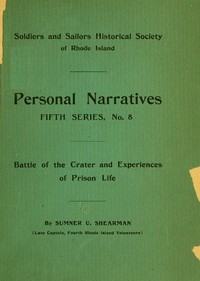
Battle of the Crater; and Experiences of Prison Life — Background and Themes
3048
4
Project Gutenberg
2014
United States -- History -- Civil War, 1861-1865 -- Prisoners and prisons; Petersburg Crater, Battle of, Va., 1864
Readers of public-domain and historical texts
Project Gutenberg digital edition
en
Edition facts
Words: 10,207
Reading time: 45 min
Text sections: 1
Source:
Project Gutenberg record #47778
Captain Sumner U. Shearman's 1898 account of the Battle of the Crater and his subsequent imprisonment in Charleston, S.C., based on a paper read before the Rhode Island Soldiers and Sailors Historical Society. The narrative shifts from tactical detail to the daily realities of captivity, including escape attempts and the makeshift ingenuity of prisoners.
Sumner U. Shearman, captain of Company A, Fourth Rhode Island Volunteers, opens his narrative with a precise chronology: the regiment rejoined the Ninth Corps on July 4, 1864, and the Battle of the Crater was fought on July 30. His account, originally a paper read before the Rhode Island Soldiers and Sailors Historical Society, moves from the tactical situation—lines 150 to 300 yards apart, constant sniper fire—to the cramped, dangerous life in the rifle pits, where casualties occurred every rotation. The voice is that of a veteran speaking to comrades, grounding each observation in personal experience.
The Mine and the Crater
Shearman describes the plan to explode a mine under the Confederate lines, credited to Lieutenant-Colonel Henry Pleasants of the 48th Pennsylvania. He notes the regiment's position in the Ninth Corps under General Burnside, but the excerpts do not detail the explosion itself or the assault. Instead, the narrative focuses on the waiting: the camp in the woods, the barricade built for protection, and the routine of forty-eight-hour stints in the rifle pits. The language is matter-of-fact, with no dramatic flourishes—Shearman reports that men were killed or wounded every time they entered the pits. This understated tone suggests a speaker more concerned with accuracy than with heroics.
Prison Life and the Quality of the Guard
After capture, Shearman was held in a Charleston prison. He observes that the Confederate guards were often old men or boys, some barely able to carry a musket, and wore no uniform. He infers that nearly all available Confederate men were at the front. The guard changed frequently, replaced by what he calls “rustics” serving temporarily. One telling episode: three young girls, “poor white trash” from the country, ask to see a Yankee; the guard points to Shearman, and they remark he looks “just like other men.” Shearman uses this to illustrate the fantastical rumors—Yankees with horns—that circulated among the ignorant. His tone is wry, not bitter.
Escape and the Ruse of the Dummies
Shearman recounts an escape attempt by two fellow prisoners during a storm. The sentry, who usually sheltered in the porch, was avoided by using a rope made of tied blankets. The escapees were let down from a window; Shearman and others placed dummies in their places to delay discovery. The ruse worked until evening roll call. Shearman later learned the men succeeded. He also notes the prison's broken windows—glass was scarce in the Confederacy due to the blockade—and the cold prisoners endured. The narrative here is detailed and practical, focusing on the mechanics of escape and the prisoners' resourcefulness.
Prisoners' Resourcefulness
Shearman details how prisoners adapted to scarcity: blankets became ropes, dummies were made from spare clothing, and the broken windows were stuffed with rags or paper. He notes that the captain of the jail fitted up vacant spaces, but the excerpts do not specify how. The tone remains observational, avoiding self-pity. Shearman's account of the escape attempt is particularly vivid—the storm, the sentry's habits, the careful planning—and underscores the prisoners' determination despite the long odds of reaching Union lines, hunted by bloodhounds.
Shearman's narrative is valuable for its dual perspective: the soldier at the front and the prisoner behind enemy lines. His voice is that of a veteran reporting to a society of peers, which lends credibility and a certain restraint. Readers should note that the account was published in 1898, thirty-four years after the events, and likely shaped by memory and the conventions of the historical society paper. The excerpts do not cover the battle itself in detail, but the prison sections offer a sharp, unsentimental view of captivity.
Reader reflection
How did this book work for you?
Your answers remain private and are stored only in this browser.
Your progress
0
/
10
2
How did the book work for you overall?
3
Would you pass this book on to a friend?
4
Did the language feel accessible?
5
What was its emotional impact?
6
Is this a title worth rereading?
7
What did you think about the pace?
8
Would you start a conversation about this book?
9
Which lesson or insight stayed with you?
10