1

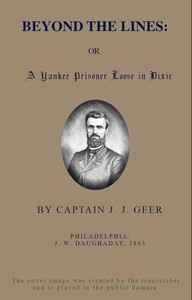
Beyond the Lines; Or, A Yankee Prisoner Loose in Dixie — A Reader’s Guide
(0 User reviews)
757
Project Gutenberg
2020
Not confirmed
United States -- History -- Civil War, 1861-1865 -- Prisoners and prisons; United States -- History -- Civil War, 1861-1865 -- Personal narratives
Readers of public-domain and historical texts
Project Gutenberg digital edition
en
Edition facts
Words
61,402
Reading time
267 min
Text sections
25
Before opening Beyond the Lines; Or, A Yankee Prisoner Loose in Dixie — A Reader’s Guide, the edition data offers a quick orientation: 61,402 words, 4 hr 27 min estimated reading time, and 25 detected text sections.
The text analysis averages about 21.1 words per sentence, while the detected sections provide another way to judge how the source is divided.
Project Gutenberg metadata also associates the work with “United States -- History -- Civil War, 1861-1865 -- Prisoners and prisons,” connecting these edition facts with the source record’s subject description.
Source:
Project Gutenberg record #63120
A firsthand narrative of capture at Shiloh, escape through Southern swamps, and recapture, structured around movement between prisons, marshes, and safe houses, with recurring images of chains, bloodhounds, and enslaved helpers.
Editorial Edition Score
4.9/5
★★★★★
★★★★★
Calculated from edition completeness, EPUB availability, text structure and catalogue metadata. Not a user rating.
How this score is calculated
- Description quality20 pts
- Title & short description10 pts
- Source metadata20 pts
- Text length15 pts
- Chapters / structure15 pts
- EPUB file integrity20 pts
Total of 100 points, scaled to a 2.5-5.0 range. Editions with an empty description or a missing EPUB file are not scored.
Edition quality
Public-domain source text
Read the source text
The source text is kept in the dedicated reader, separate from this catalogue record and its commentary.
John James Geer’s Beyond the Lines moves its reader through a geography of confinement and flight, tracing a path from the Shiloh battlefield to a series of Southern prisons, then into swamps and finally back into custody. The narrative is built on a rhythm of capture, escape, and recapture, each shift signaled by a change in setting—from guardhouse to marsh, from chain gang to a slave’s cabin. Geer’s prose is plain and direct, as promised in his preface, but the structure itself carries the drama: the reader is never allowed to settle in one place for long.
Chains and the Courtroom
The most vivid set piece in the excerpts is Geer’s speech before Confederate generals, where he turns his own chains into a prop. He recounts his father’s service at Bunker Hill and his mother’s six brothers in the War of 1812, then declares: “shoot me, hang me, cut my throat, kill me in any way you please. But, know you, that in so doing, you kill a United States soldier, who glories in these chains!” The moment is theatrical—Geer shakes his chains as he finishes—and the crowd’s reaction splits between those demanding removal of the irons and those insisting they stay. The scene encapsulates the book’s method: physical restraint (chains, jails, bloodhounds) is met with verbal defiance, and the setting itself (a courtroom turned into a stage) becomes part of the argument.
Swamps as Refuge and Trap
Geer and his companion, Lieutenant A. P. Collins, spend three weeks in “malarious marshes,” hunted by bloodhounds and sustained by slaves. The swamp is described in the prefatory poem as “the dark fens of the dismal swamp,” where “the hunted Yankees lay.” This landscape is neither picturesque nor symbolic; it is a practical hiding place that also threatens disease and recapture. The narrative moves between the swamp’s isolation and the sudden intrusion of pursuers—men on horseback, dogs, the sound of a distant camp. Geer’s account of being fed and directed by enslaved people is presented as a series of discrete encounters, each one a small drama of trust and risk. The swamp functions as a liminal space between freedom and captivity, and Geer’s prose stays close to the sensory details: the horses’ tramp, the bloodhounds’ bay.
The Haunted Church and the Sweet-Potato Patch
One of the book’s most peculiar episodes involves a haunted church and a sweet-potato patch. After escaping, Geer and Collins hide in an old church surrounded by graves. A local captain, testing the bravery of their pursuers, tells them the building is haunted and that headless men rise from the graves. The pursuers turn back. Later, the same captain reveals he had been under bond for good behavior, and the sheriff who shelters Geer is a Western Virginia man with Union sympathies. These vignettes show how the narrative weaves together chance, superstition, and the hidden politics of ordinary people. The sweet-potato patch itself becomes a site of near-discovery, a reminder that the landscape is full of both food and danger.
The Rhythm of Recapture
Geer’s story does not end with escape. The excerpts show a pattern: capture, trial, flight, assistance from slaves, recapture, and finally release on exchange. This cyclical structure is announced in the preface, which lists the sequence of events as a series of “hows”—how he was tried, chained, escaped, lived in swamps, was hunted, and was finally exchanged. The movement between settings—Columbus, Mississippi; Montgomery, Alabama; Macon, Georgia—creates a map of the Confederacy’s prison system. Each new location brings a new set of captors and a new chance for flight. The narrative’s momentum depends on this constant shifting, and Geer’s plain style keeps the focus on action rather than reflection. The reader is left with the sense that captivity is never final, and freedom is always temporary.
Readers will find that Beyond the Lines rewards attention to its small details: the name of a helpful slave, the description of a log house, the exact wording of a threat. The narrative’s power lies not in grand themes but in the accumulation of specific, often contradictory encounters—with cruelty, with kindness, with fear and with luck. Approach it as a document of survival, shaped by the constraints of its time and the author’s determination to tell a “plain, straightforward, unvarnished account.”
Reading about that Yankee prisoner slipping through Southern swamps, I recalled my father’s old war stories, told on quiet evenings. There is a particular ache in those remembrances of place and loss, something I felt again browsing Chattanooga and Chickamauga Reprint of Gen. H. V. Boynton's letters to the Cincinnati Commercial Gazette, August, 1888. — Key Ideas to Explore, where the land itself seems to hold the echoes of what happened there.
There are no reviews for this eBook.
There are no comments for this eBook.
Reader reflection
How did this book work for you?
Your answers remain private and are stored only in this browser.
Your progress
0
/
10
2
How much did you enjoy the reading experience?
3
Would you recommend this book to another reader?
4
How much effort did this book require?
5
Was the book what you thought it would be?
6
How distinctive were its ideas or approach?
7
Would a second reading be valuable?
8
What was the strongest part of the book?
9
Which lesson or insight stayed with you?
10