1

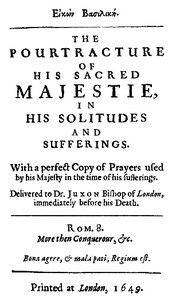
Eikon Basilike The Pourtracture of His Sacred Majestie, in His Solitudes and Sufferings — Reading Companion
(0 User reviews)
454
Project Gutenberg
2010
Not confirmed
Charles I, King of England, 1600-1649 -- Early works to 1800; Great Britain -- History -- Civil War, 1642-1649
Readers of public-domain and historical texts
Project Gutenberg digital edition
en
Edition facts
Words
65,906
Reading time
287 min
Text sections
9
The catalog record for Eikon Basilike The Pourtracture of His Sacred Majestie, in His Solitudes and Sufferings — Reading Companion provides practical reading context through 65,906 words, 4 hr 47 min estimated reading time, and 9 detected text sections.
The text analysis averages about 43.1 words per sentence, while the detected sections provide another way to judge how the source is divided.
Project Gutenberg metadata also associates the work with “Charles I, King of England, 1600-1649 -- Early works to 1800,” connecting these edition facts with the source record’s subject description.
Source:
Project Gutenberg record #32188
This edition of Eikon Basilike presents the text attributed to Charles I, composed during his imprisonment, with a preface and emblematic frontispiece. The work combines personal reflection, political apology, and religious devotion, structured as a series of meditations on key events of the Civil War.
Editorial Edition Score
4.7/5
★★★★★
★★★★★
Calculated from edition completeness, EPUB availability, text structure and catalogue metadata. Not a user rating.
How this score is calculated
- Description quality20 pts
- Title & short description10 pts
- Source metadata20 pts
- Text length15 pts
- Chapters / structure15 pts
- EPUB file integrity20 pts
Total of 100 points, scaled to a 2.5-5.0 range. Editions with an empty description or a missing EPUB file are not scored.
Edition quality
Public-domain source text
Read the source text
The source text is kept in the dedicated reader, separate from this catalogue record and its commentary.
The volume opens with an emblematic frontispiece and a Latin poem that establishes a tone of royal suffering and spiritual triumph. The king is depicted as a palm tree weighed down but rising, a rock unmoved by storms, and a figure who tramples an earthly crown while embracing a crown of thorns. This visual and poetic preface immediately frames the work as both a political defense and a devotional exercise, inviting readers to see the king's misfortunes as a path to heavenly reward.
The table of contents lists twenty-eight chapters, each focused on a specific event from the calling of the Long Parliament to the denial of chaplains. This structure suggests a chronological yet selective narrative of the king's perspective on the Civil War, emphasizing personal grievance and divine providence.
The Emblematic Frame
The opening pages of Eikon Basilike are not merely decorative; they establish a visual and rhetorical program that governs the entire work. The frontispiece, with its Latin verses and English translation, presents the king as a figure of passive endurance: “Though clogg'd with weights of miseries, Palm-like depress'd, I higher rise.” This image of resilience under pressure recurs throughout the text. The emblem also contrasts two crowns: a “splendid, but yet toilsome Crown” that is trampled, and a “heav'nly Crown” viewed with “eyes of faith divine.” This binary—earthly suffering versus celestial reward—provides a key to interpreting the king's narrative of political defeat as spiritual victory.
A Defense of Episcopacy
In the excerpt on church government, the king argues for the divine right of episcopacy, claiming that “for 1500 years not one Example can be produced of any setled Church, wherein were many Ministers and Congregations, which had not some Bishop above them.” He grounds this claim in Scripture, citing the Epistles to Timothy and Titus as evidence for a distinct office of “President-Bishops” with authority over ordination and censures. The tone is polemical: he accuses opponents of being “perverse Disputers, and proud Usurpers” who lack “sound Doctrine.” This section reveals the king's commitment to ecclesiastical hierarchy as inseparable from political order.
The King's Voice and Persona
Throughout the excerpts, the king adopts a persona of injured innocence and moral authority. He presents himself as a victim of misrepresentation, writing to “clear my self of those imputations” cast upon him. The language is often legalistic and self-justifying, as when he insists that his actions were “not to beleeve their pretended grounds.” Yet there is also a devotional register, especially in the prayers appended to the text. The combination of political apology and personal piety creates a hybrid genre that is neither straightforward memoir nor pure meditation. Readers should attend to shifts in tone between defensive argument and pious resignation.
Structure and Selection of Events
The table of contents reveals a deliberate ordering of grievances, from the calling of the Long Parliament to the denial of chaplains. Each chapter title begins with “Upon,” signaling a reflective rather than strictly narrative mode. The king does not simply recount events; he interprets them as trials sent by God. For instance, the chapter “Upon the various events of the War; Victories, and Defeats” suggests a providential reading of military outcomes. The final chapters, dealing with captivity and the loss of chaplains, intensify the theme of isolation. This structure guides the reader to see the king's life as a passion narrative, culminating in martyrdom.
Readers approaching Eikon Basilike for the first time should pay attention to how the king frames his own story through biblical and classical allusions. The work rewards careful reading of its prefatory material, which sets the terms for interpreting the chapters that follow. Because the text is both a political document and a work of devotion, it invites multiple readings: as royalist propaganda, as personal testimony, and as a specimen of seventeenth-century religious writing.
I found myself thinking about how a king, alone and writing, tried to make sense of everything falling apart—his words less a defense than a quiet prayer for understanding. It reminded me of another voice, years later, asking the same painful questions about authority and loyalty. The Justice and Necessity of Taxing the American Colonies, Demonstrated Together with a Vindication of the Authority of Parliament — Background and Themes sits nearby on my shelf, and somehow they speak to each other across time, both so certain, both so haunted.
There are no reviews for this eBook.
There are no comments for this eBook.
Reader reflection
Your personal reading reflection
Build a private reading journal entry for this title.
Your progress
0
/
10
2
What was your overall reaction to the book?
3
How likely are you to recommend this book?
4
How much effort did this book require?
5
Would you read this book again?
6
How useful were the ideas in this book?
7
How closely did the book connect with your experience?
8
How distinctive were its ideas or approach?
9
Which lesson or insight stayed with you?
10