1

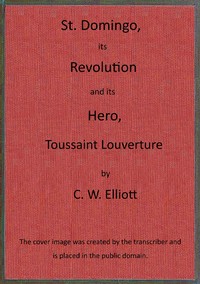
St. Domingo, its revolution and its hero, Toussaint Louverture. — Reading Companion
(0 User reviews)
748
Project Gutenberg
2023
Not confirmed
Toussaint Louverture, 1743-1803; Haiti -- History -- Revolution, 1791-1804
Readers of public-domain and historical texts
Project Gutenberg digital edition
en
Edition facts
Words
21,817
Reading time
95 min
Text sections
25
The catalog record for St. Domingo, its revolution and its hero, Toussaint Louverture. — Reading Companion provides practical reading context through 21,817 words, 1 hr 35 min estimated reading time, and 25 detected text sections.
The text analysis averages about 18.2 words per sentence, while the detected sections provide another way to judge how the source is divided.
Project Gutenberg metadata also associates the work with “Toussaint Louverture, 1743-1803,” connecting these edition facts with the source record’s subject description.
Source:
Project Gutenberg record #70281
Elliott's 1855 lecture traces Toussaint Louverture's rise amid Haiti's revolution, using the island's geography, racial conflicts, and Toussaint's own proclamations to frame a moral argument about black capacity for self-governance.
Editorial Edition Score
4.8/5
★★★★★
★★★★★
Calculated from edition completeness, EPUB availability, text structure and catalogue metadata. Not a user rating.
How this score is calculated
- Description quality20 pts
- Title & short description10 pts
- Source metadata20 pts
- Text length15 pts
- Chapters / structure15 pts
- EPUB file integrity20 pts
Total of 100 points, scaled to a 2.5-5.0 range. Editions with an empty description or a missing EPUB file are not scored.
Edition quality
Public-domain source text
Read the source text
The source text is kept in the dedicated reader, separate from this catalogue record and its commentary.
Elliott opens his 1855 lecture with a blunt moral purpose: to weaken the 'bitter prejudice of color' that denies black people citizenship, communion, and even entry into heaven. He frames Toussaint Louverture as a model who 'was not more ashamed of being black than he should be of being white.' The text is structured as a series of short chapters—twenty in total—moving from the island's natural beauty (Columbus called it 'The Paradise of God') through the devastation of Spanish conquest and the slave trade, to the revolution itself. Elliott's voice is urgent, often editorial, and he relies on contemporary sources like Lacroix and Rainsford. Readers should note that this is not a neutral history but a polemical biography, condensed from a longer discourse for the New York Library Association.
A Moral Argument Framed by Geography
The first two chapters establish a stark contrast. Chapter I declares the book's anti-racist intent outright. Chapter II then pivots to a lush description of St. Domingo as a 'Paradise' ruined by Spanish greed—'a million of the simple natives was sacrificed without mercy or care' for gold. Elliott uses the island's beauty as a foil for European brutality, a pattern that recurs when he later describes Toussaint's agricultural reforms. The geography is not backdrop but evidence: a fertile land made barren by war and slavery, then restored under Toussaint's rule. This rhetorical move—setting natural abundance against human destruction—prepares readers to see Toussaint as a restorer of order, not just a rebel leader.
Toussaint's Voice in the Pulpit
One of the most striking passages comes in Chapter VII, when Toussaint enters Aux Cayes after defeating Rigaud. Elliott places him in a pulpit, 'firm, sad, perhaps severe,' and quotes his proclamation: 'Forgive us our transgressions as we forgive those who transgress against us.' The language is explicitly biblical, and Toussaint calls for a general amnesty, urging citizens to 'let the past be forgotten.' Elliott does not resolve whether this is mercy, wisdom, or craftiness—he leaves the question open. This moment is the emotional hinge of the excerpts: it shows Toussaint wielding moral authority, not just military power. Readers should watch for how Elliott later contrasts this clemency with the treachery of Napoleon and the ferocity of Dessalines.
The Architecture of a New State
After the pacification of the colony, Elliott lists Toussaint's principles in a series of declarative sentences: agriculture as the 'material basis' of prosperity; security of life and property; restoration of churches and schools; and the necessity of armed self-defense. These are presented as Toussaint's own ideas, 'founded upon the profoundest instincts of human nature.' The list is schematic, almost like a constitution. Elliott does not describe how these policies were implemented—the excerpts cut off before details of Toussaint's labor system or his conflicts with the black majority. But the structure itself is revealing: Elliott is building a case for Toussaint as a statesman, not just a general. The reader should note that this section is aspirational; the subsequent chapters on Napoleon and betrayal will test these ideals.
Elliott's Use of Sources and Silences
Elliott cites Lacroix, Rainsford, and Beard in footnotes, but he does not always distinguish between his own interpretation and his sources' claims. For example, he writes that Rigaud 'was surpassed by the ferocity of Dessalines' without specifying whose account he follows. The excerpts also omit Toussaint's capture and death—Chapter XX is titled 'Death' but the text provided ends before it. This means readers encounter Toussaint at his peak, not his fall. Elliott's narrative arc is thus deliberately shaped: he emphasizes triumph and moral clarity, leaving the tragic end to the final pages. A careful reader will note that the excerpts give no direct access to Toussaint's own writings beyond the quoted proclamation; Elliott mediates everything through his own moral lens.
Because the excerpts end before Toussaint's imprisonment and death, readers should pay close attention to how Elliott handles the transition from triumph to tragedy in the final chapters. The lecture's structure—twenty short chapters—invites comparison between the early sections on slavery and the later ones on betrayal. Elliott's footnotes point to contemporary biographies; consulting those might clarify where his account diverges from other sources. Above all, read this as a document of 1855 America, where the question of black citizenship was violently contested, and Elliott's Toussaint is a weapon in that fight.
I keep thinking about how Elliott framed Toussaint’s struggle—the weight of a man carrying a nation’s hope on his shoulders. It reminded me of another quiet, sorrowful voice, a king writing alone about dignity when everything was stripped away. That loneliness, that inward steadiness amid ruin, stayed with me the same way. Eikon Basilike The Pourtracture of His Sacred Majestie, in His Solitudes and Sufferings — Reading Companion felt like a whispered echo of that same patient strength.
There are no reviews for this eBook.
There are no comments for this eBook.
Reader reflection
How will you remember this book?
Save your reaction, strongest insight, and memorable passage.
Your progress
0
/
10
2
How did the book work for you overall?
3
Would you pass this book on to a friend?
4
How demanding did the text feel?
5
Did it raise ideas you would like to talk about?
6
Could you follow the author’s main argument?
7
Did the book deliver what you hoped for?
8
What did you appreciate most?
9
In one sentence, what did you learn?
10