1

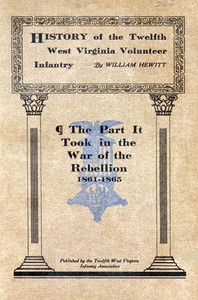
History of the Twelfth West Virginia Volunteer Infantry The Part It Took in the War of the Rebellion, 1861-1865 — Reading Companion
(0 User reviews)
377
Project Gutenberg
2014
Not confirmed
United States -- History -- Civil War, 1861-1865 -- Regimental histories; United States. Army. West Virginia Infantry Regiment, 12th (1862-1865) -- History; West Virginia -- History -- Civil War, 1861-1865 -- Regimental histories
Readers of public-domain and historical texts
Project Gutenberg digital edition
en
Edition facts
Words
77,531
Reading time
338 min
Text sections
7
The source record for History of the Twelfth West Virginia Volunteer Infantry The Part It Took in the War of the Rebellion, 1861-1865 — Reading Companion measures this digital text at 77,531 words, 5 hr 38 min estimated reading time, and 7 detected text sections.
The text analysis averages about 21.8 words per sentence, while the detected sections provide another way to judge how the source is divided.
Project Gutenberg metadata also associates the work with “United States -- History -- Civil War, 1861-1865 -- Regimental histories,” connecting these edition facts with the source record’s subject description.
Source:
Project Gutenberg record #45233
William Hewitt's regimental history of the 12th West Virginia Volunteer Infantry, compiled from memory and comrades' contributions decades after the Civil War, offers a candid, anecdotal account of the unit's campaigns, including the Battle of New Market, with a defensive tone about General Sigel's performance.
Editorial Edition Score
4.7/5
★★★★★
★★★★★
Calculated from edition completeness, EPUB availability, text structure and catalogue metadata. Not a user rating.
How this score is calculated
- Description quality20 pts
- Title & short description10 pts
- Source metadata20 pts
- Text length15 pts
- Chapters / structure15 pts
- EPUB file integrity20 pts
Total of 100 points, scaled to a 2.5-5.0 range. Editions with an empty description or a missing EPUB file are not scored.
Edition quality
Public-domain source text
Read the source text
The source text is kept in the dedicated reader, separate from this catalogue record and its commentary.
William Hewitt begins his regimental history not with a battle cry but with a confession of reluctance. In the preface, he admits that the task of compiling the Twelfth West Virginia’s story was “thrust upon” him at a reunion in 1889, and that he initially declined due to the “magnitude, burden and difficulty” of the work. This personal framing sets the tone for a narrative that is as much about the challenges of memory as about the war itself. Hewitt relies on comrades’ contributions and acknowledges the “almost total lack of official records” thirty years after the fact, making the resulting account a deliberate, self-aware construction rather than an authoritative chronicle.
A Compilation Built on Memory and Gaps
Hewitt’s preface is unusually transparent about the book’s limitations. He notes that he inserted cards in newspapers and wrote letters to solicit incidents, but that “where there is failure to make mention of incidents worthy of record … it is because they were not known, or are not remembered.” This admission shapes the entire work: the history is not a seamless official record but a patchwork of recollections, some generous, some missing. The dedication “To the Surviving Comrades and the Families of the Fallen” further underscores that the intended audience is the regiment itself, not a broad public. Readers should expect a text that values personal anecdote over strategic overview, and that openly grapples with the fallibility of memory.
The Battle of New Market: Defense of Sigel and a Humorous Aside
The excerpts from the New Market engagement reveal two distinct authorial impulses. First, Hewitt mounts a pointed defense of General Sigel, quoting Halleck’s dismissive telegram—“Sigel is in full retreat … he will do nothing but run”—and countering that Sigel “acted bravely” and that his entire command would testify to his courage. This is a rare moment of explicit argument, suggesting that Hewitt saw his history partly as a corrective to official narratives. Second, he includes a comic anecdote about Colonel Wells of the Thirty-fourth Massachusetts, whose repeated order “Orderly, orderly go and ascertain who fired that gun” became a running joke among the men. The juxtaposition of battlefield critique with barracks humor is characteristic of Hewitt’s method: he moves from tactical analysis to soldierly jest without transition, treating both as equally valid parts of the regiment’s experience.
Scouting, Disobedience, and the Texture of Camp Life
Hewitt’s account of a volunteer scouting mission after New Market illustrates how the history captures informal dynamics. Corporal De Bee and six to eight men are ordered by Sigel to don civilian clothes and infiltrate the enemy camp. The men silently decide to “forego that pleasure” and instead reconnoiter in uniform, counting tents from a hillside. When they return, they are arrested by pickets who do not recognize them. Sigel later praises them above the cavalry. The episode is told with dry understatement—the men’s unspoken refusal to wear civilian clothes, the irony of being arrested by their own side—and it reveals how Hewitt privileges the soldiers’ perspective over strict obedience. Such vignettes, scattered through the text, give the history a ground-level texture that official reports lack.
Hewitt’s history is best approached as a veteran’s conversation with his comrades, not as a comprehensive operational record. The catalog subjects—regimental history, West Virginia’s role—are accurate but incomplete: the book’s value lies in its candid acknowledgment of memory’s limits and its inclusion of humor and dissent alongside battle accounts. Readers interested in the Civil War’s human dimensions will find more here than in a dry tactical summary, but they should also expect gaps and a partisan defense of the regiment’s reputation.
Hewitt’s defensive tone about Sigel made me recall my grandfather recounting Coal Creek strikes—always excusing the failed. That same ache of memory-as-justification surfaced in The Swedish Revolution Under Gustavus Vasa — A Reader’s Guide, where loyal retellings soften every setback. I’ve kept both books on low shelves, their dog-eared pages smelling of rain and stubbornness.
There are no reviews for this eBook.
There are no comments for this eBook.
Reader reflection
Before you leave, reflect on the book
Use these questions to collect your thoughts before moving on.
Your progress
0
/
10
2
Did this book hold your interest?
3
How likely are you to recommend this book?
4
Did the language feel accessible?
5
Did you relate to its people, ideas, or situations?
6
Was the book what you thought it would be?
7
Was the book moving at the right speed?
8
Did you gain anything practical from the text?
9
What is the main idea you are taking away?
10