1

Empire Partnership — Edition Insights
(0 User reviews)
391
Project Gutenberg
2014
Not confirmed
Canada -- Foreign relations -- Great Britain; Great Britain -- Foreign relations -- Canada
Readers of public-domain and historical texts
Project Gutenberg digital edition
en
Edition facts
Words
6,248
Reading time
28 min
Text sections
2
Empire Partnership — Edition Insights can be approached with a clearer sense of reading commitment from its source measurements: 6,248 words, 28 min estimated reading time, and 2 detected text sections.
The text analysis averages about 27.8 words per sentence, while the detected sections provide another way to judge how the source is divided.
Project Gutenberg metadata also associates the work with “Canada -- Foreign relations -- Great Britain,” connecting these edition facts with the source record’s subject description.
Source:
Project Gutenberg record #47347
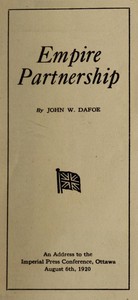
In this 1920 address to the Imperial Press Conference, John W. Dafoe contrasts pre-war fears of 'Armageddon' with postwar hopes for a partnership of equals, using the conference's own history to frame a shift from imperial defence to shared citizenship.
Editorial Edition Score
4.4/5
★★★★★
★★★★★
Calculated from edition completeness, EPUB availability, text structure and catalogue metadata. Not a user rating.
How this score is calculated
- Description quality20 pts
- Title & short description10 pts
- Source metadata20 pts
- Text length15 pts
- Chapters / structure15 pts
- EPUB file integrity20 pts
Total of 100 points, scaled to a 2.5-5.0 range. Editions with an empty description or a missing EPUB file are not scored.
Edition quality
Public-domain source text
Read the source text
The source text is kept in the dedicated reader, separate from this catalogue record and its commentary.
John W. Dafoe opens his 1920 address to the Imperial Press Conference by recalling how the first conference, eleven years earlier, was dominated by the word 'Armageddon.' Speakers then—Lord Rosebery, Stanley Reed, Arthur Balfour, Lord Roberts—competed in prophecies of global conflict, with Roberts warning that 'a shot fired in the Balkan peninsula might produce an explosion.' Dafoe uses these remembered predictions to measure the distance from pre-war anxiety to postwar possibility. The structure of his talk is itself a hinge: the first half revisits the failed push for formal imperial defence machinery; the second half argues that shared war experience has created a new basis for union, one rooted not in contracts but in 'common aspirations.'
Two Schools of Imperial Thought
Dafoe identifies two opposing groups that shaped pre-war imperial debate. One, which he calls 'the school of Burke,' placed 'very little reliance on forms and a great deal of reliance on spiritual ties and the bonds of blood.' The other, 'the school of Hamilton,' held that 'sentiment was very well' but insufficient without binding structures. This dichotomy recurs throughout the address as a framing device. Dafoe does not explicitly endorse either camp; instead, he suggests that the war has rendered the old quarrel obsolete. The Burkean position, he implies, has been vindicated by events, but he avoids declaring victory. Instead, he uses the two schools to show that the empire’s constitutional evolution has been a series of pragmatic compromises, not ideological triumphs.
The War as a Turning Point
Dafoe treats the First World War not merely as a catastrophe but as 'a great turning point in human history' that marks 'a definite break in the old order.' The old order, he argues, was characterized by 'the aggrandisement of peoples, nations, in a military sense or in a commercial sense.' The new order, by contrast, aims at 'the enlargement of individual life, and the bettering of the life of the common people.' This shift from nation-centric to people-centric politics is the core of his argument for a renewed imperial partnership. He invokes Lincoln’s remark that 'the Lord must love them since He made so many of them' to ground his vision in democratic sentiment rather than imperial hierarchy. The war, in his telling, has transformed the empire from a defensive alliance into a community of shared sacrifice.
Recurring Images of Prophecy and Memory
Dafoe’s address is structured around a series of recalled speeches and their aftermaths. He quotes Lord Roberts’s 1909 warning about a Balkan spark, then notes that the battle of the Falkland Islands vindicated Stanley Reed’s guess about Cape Horn. Arthur Balfour’s prediction that the naval Armageddon would be fought in British waters is also confirmed. These retrospective validations serve a rhetorical purpose: they establish the first conference as a moment of genuine foresight, lending weight to Dafoe’s own claims about the future. The repeated image of prophecy—accurate, near-accurate, or dramatically off—creates a pattern of expectation and fulfillment. Dafoe positions himself as the latest in a line of speakers whose words will be tested by events, inviting his audience to judge his vision against the coming years.
A Place for the United States
In his closing paragraphs, Dafoe extends his partnership vision beyond the dominions to include the United States. He describes America as 'that great sister-nation kindred to ourselves, with the same blood-strains,' and suggests that the break in 'historic continuity' caused by the Revolution is 'a very little thing' in the 'ampler air of the new day.' The different form of government, he adds, is 'a matter of no consequence at all.' This move is striking because it reframes empire not as a legal structure but as a cultural and linguistic community. Dafoe’s final hope is for 'the society of English-speaking nations,' with Britain as 'first among equals' and America at her side. The address thus ends by expanding its scope from imperial federation to a broader Anglo-Saxon alliance, a shift that reflects the postwar mood of internationalism.
Dafoe’s address is best read as a document of its moment—a speech that uses the conference’s own history to argue for a looser, more voluntary imperial bond. Readers should note how he balances the authority of past prophecies with the uncertainty of future aspirations, and how his references to specific speakers (Roberts, Balfour, Lincoln) anchor his argument in concrete testimony. The text rewards attention to its rhetorical structure: the movement from remembered fear to present hope, from defence to partnership, from empire to English-speaking world.
Reading Dafoe's hopeful talk of a postwar partnership made me think of quieter rooms, of slow domestic records where change creeps in through kitchens and letters rather than declarations. Domestic Annals of Scotland from the Reformation to the Revolution, Volume 2 (of 2) — Background and Themes shares that same understated pulse—a nation’s shifting identity felt most truly in everyday habits, not just grand speeches.
There are no reviews for this eBook.
There are no comments for this eBook.
Reader reflection
How will you remember this book?
Save your reaction, strongest insight, and memorable passage.
Your progress
0
/
10
2
How did the book work for you overall?
3
How likely are you to recommend this book?
4
How demanding did the text feel?
5
How valuable was this book for your own interests?
6
How closely did the book connect with your experience?
7
Did the book deliver what you hoped for?
8
What did you think about the pace?
9
What did this book teach you most?
10