1

Life and Remarkable Adventures of Israel R. Potter — A Closer Reading
(0 User reviews)
661
Project Gutenberg
2021
Not confirmed
United States -- History -- Revolution, 1775-1783 -- Prisoners and prisons; United States -- History -- Revolution, 1775-1783 -- Personal narratives; Potter, Israel, 1744-1826?
Readers of public-domain and historical texts
Project Gutenberg digital edition
en
Edition facts
Words
38,187
Reading time
167 min
Text sections
21
For Life and Remarkable Adventures of Israel R. Potter — A Closer Reading, the stored edition analysis reports 38,187 words, 2 hr 47 min estimated reading time, and 21 detected text sections.
The text analysis averages about 43.3 words per sentence, while the detected sections provide another way to judge how the source is divided.
Project Gutenberg metadata also associates the work with “United States -- History -- Revolution, 1775-1783 -- Prisoners and prisons,” connecting these edition facts with the source record’s subject description.
Source:
Project Gutenberg record #66684
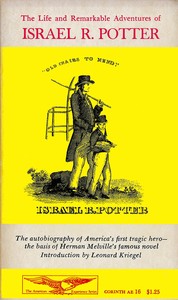
Israel Potter's 1824 autobiography, a source for Melville's novel, recounts his Revolutionary War service, captivity, and decades of poverty in London, including street cries of 'Old Chairs to Mend.' This edition includes Melville's appendix and an introduction by Leonard Kriegel.
Editorial Edition Score
4.8/5
★★★★★
★★★★★
Calculated from edition completeness, EPUB availability, text structure and catalogue metadata. Not a user rating.
How this score is calculated
- Description quality20 pts
- Title & short description10 pts
- Source metadata20 pts
- Text length15 pts
- Chapters / structure15 pts
- EPUB file integrity20 pts
Total of 100 points, scaled to a 2.5-5.0 range. Editions with an empty description or a missing EPUB file are not scored.
Edition quality
Public-domain source text
Read the source text
The source text is kept in the dedicated reader, separate from this catalogue record and its commentary.
Israel R. Potter's 1824 narrative, reprinted here with an introduction by Leonard Kriegel and an appendix from Herman Melville's 1855 novelization, presents a first-person account that resists easy categorization. The catalog lists it under 'United States -- History -- Revolution, 1775-1783 -- Prisoners and prisons' and 'Personal narratives,' but the excerpts reveal a text that dwells far more on postwar London poverty than on battlefield action. Potter describes becoming 'an expert workman at brick making' and later a street chair-bottomed, crying 'Old Chairs to Mend' through the streets. The narrative's focus on economic struggle rather than military heroism complicates its classification as a straightforward Revolutionary memoir.
A Memoir of Postwar Hardship
The catalog subjects emphasize Potter's Revolutionary War experience, but the excerpts show that the bulk of his account concerns the decades after peace. Potter notes that 'the peace had thrown thousands who had taken an active part in the war, out of employ' and that London was 'thronged with them.' His own wages fell so low that he had to abandon brick making for chair bottoming, a trade he learned from an acquaintance. The narrative's emotional weight falls on his inability to return home: he could have secured passage at government expense, but 'as this was a privilege that could not be extended to my wife and child, my regard for them prevented my embracing' it. This detail—a soldier choosing family over repatriation—shifts the memoir from war story to chronicle of displacement.
The Voice of the Street Crier
Potter's prose is plain and circumstantial, but it gains texture when he describes his new occupation. He writes that success depended 'in a great measure, in being enabled to drown the voices of others (engaged in the same occupation) by my own.' The cry 'Old Chairs to Mend' became his constant refrain 'from morning to night.' This is not the language of a military memoir but of an urban laborer adapting to a harsh economy. The text's structure—moving from war to a London street trade—undermines the catalog's implied arc of patriotic service. Potter's 'remarkable adventures' turn out to be less about battles than about surviving as a poor immigrant in a city where he was 'almost stunned' by the 'cries of London.'
Melville's Shadow and the Text's Authenticity
This edition includes Melville's fictionalized version as an appendix, and the introduction by Leonard Kriegel frames Potter's narrative as 'the autobiography of America’s first tragic hero.' Yet the excerpts show that Potter's own text is notably unheroic: he describes himself as 'resigned and reconciled' to his situation, bearing afflictions 'with a degree of fortitude which I could hardly have believed myself possessed of.' Melville's dedication (reproduced in the front matter) calls the original 'a little narrative of his adventures, forlornly published on sleazy gray paper' and speculates it was 'written, probably not by himself, but taken down from his lips by another.' Readers should note that the voice in these pages may be mediated, and that the catalog's 'Personal narratives' tag may oversimplify the text's collaborative or transcribed origins.
Readers approaching this text through the catalog's Revolutionary War subjects will find a narrative that resists that frame. Potter's account is less about the war itself than about its aftermath—a long, grinding exile in London's laboring class. The inclusion of Melville's appendix invites comparison between the plainspoken original and the literary adaptation. Pay attention to the moments when Potter describes his work, his family, and his street cries; these are the details that distinguish his memoir from a conventional soldier's tale.
I remember Israel Potter’s worn pages, his London cries echoing through years of exile. That same lonely ache lives in The Bride of Fort Edward: Founded on an Incident of the Revolution — A Reader’s Guide, where the war’s shadow falls on a quieter, private sorrow. Both books whisper of loss, and sitting between them, I felt a strange, tender kinship.
There are no reviews for this eBook.
There are no comments for this eBook.
Reader reflection
How will you remember this book?
Save your reaction, strongest insight, and memorable passage.
Your progress
0
/
10
2
How did the book work for you overall?
3
Is this a title you would suggest to others?
4
How much effort did this book require?
5
What was its emotional impact?
6
How well did it match your expectations?
7
Did the book give you something worth debating?
8
How would you describe its reading pace?
9
Which lesson or insight stayed with you?
10