1

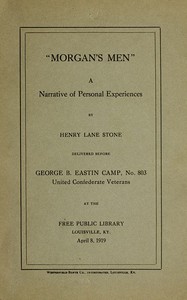
"Morgan's Men," a Narrative of Personal Experiences — Reading Companion
538
3
Project Gutenberg
2015
United States -- History -- Civil War, 1861-1865 -- Personal narratives, Confederate; Confederate States of America. Army. Morgan's Cavalry Division
Readers of public-domain and historical texts
Project Gutenberg digital edition
en
Edition facts
Words: 12,286
Reading time: 54 min
Text sections: 2
Source:
Project Gutenberg record #50033
Henry Lane Stone's 1919 address to Confederate veterans recounts his service in Morgan's Cavalry Division, focusing on prison escapes, disguises, and postwar reunions, with specific incidents like a tense ferry encounter and a misidentified detective.
Editorial Edition Score
4.5/5
★★★★★
★★★★★
Calculated from edition completeness, EPUB availability, text structure and catalogue metadata. Not a user rating.
Edition quality
Henry Lane Stone delivered this address to the George B. Eastin Camp of United Confederate Veterans in Louisville on April 8, 1919, and it was later printed as a pamphlet at the suggestion of the Louisville Evening Post. The narrative is not a full memoir but a spoken recollection, shaped by the occasion and the audience of fellow veterans. Stone, a lawyer and general counsel for the Louisville & Nashville Railroad, frames his experiences through specific, often tense, episodes rather than a continuous campaign history.
The catalog subjects classify the work under Confederate personal narratives and Morgan's Cavalry Division, but the excerpts reveal a narrower focus: Stone dwells on life as a fugitive, narrow escapes, and the aftermath of the war, with little tactical detail. The address's origin as a camp talk influences its tone—direct, anecdotal, and reliant on shared knowledge among listeners.
A Fugitive's Disguises and Narrow Misses
Stone's account emphasizes the constant need for concealment. He describes registering at hotels under assumed names, checking the register to recall his alias, and the relief of a mistaken identity when a man demanding settlement only meant his supper bill. A more personal evasion occurs on a ferry at Covington, where he spots his uncle, Higgins Lane, an intense Union man, and dodges him to avoid arrest. Stone later learns his uncle would not have turned him in, a revelation that underscores the divided loyalties within families.
These episodes are not heroic charges but quiet, anxious moments of survival. The ferry incident, in particular, shows how Stone's narrative privileges personal risk over military action. The catalog subject of Morgan's Cavalry Division is present only indirectly—through Stone's status as a member—while the actual content dwells on the logistics of escape.
Prison Escapes and the Joy of News
Stone recounts reading in a Cincinnati newspaper about General Morgan's escape from the Ohio State Prison, an event that made his heart leap but forced him to suppress any reaction. He calls the escape "without a parallel in military history," a claim that reflects the pride of Morgan's men. The narrative also includes a kindness from Colonel George St. Leger Grenfell, a British officer on Morgan's staff, who lent Stone a horse when his own was injured. Grenfell later was imprisoned at Fort Jefferson for alleged involvement in a plot to free Confederate prisoners from Camp Douglas.
These passages show Stone's admiration for specific individuals and their daring. The catalog's "personal narratives" subject fits, but the excerpts offer no broader context of Morgan's raids; instead, they highlight isolated acts of ingenuity and loyalty.
Postwar Reconciliation and the Veteran's Lens
The address's framing as a camp talk shapes its content. Stone includes a newspaper editorial praising Morgan's men as good citizens after the war, listing names like Basil W. Duke and John B. Castleman. This editorial, reprinted in the preface, serves as a validation of the veterans' place in reunited America. Stone himself notes that his uncle later visited his home in Owingsville, and they entertained him hospitably—a small gesture of reconciliation.
The catalog's secondary topic "biography-memoir" is accurate, but the work is more a curated set of anecdotes than a full autobiography. Stone's narrative is selective, emphasizing moments of tension and relief rather than a chronological service record. Readers should approach it as a veteran's oral history, shaped by the 1919 reunion context and the desire to honor comrades.
Stone's address offers a narrow but vivid window into the experiences of Morgan's men, filtered through memory and the conventions of a camp meeting. Readers interested in the social dynamics of Confederate veterans' organizations or the personal logistics of evasion will find more substance here than those seeking a tactical history. The work's value lies in its specific, unpolished details—the alias on a hotel register, the ferry boat dodging, the newspaper read in secret—rather than in any comprehensive account of the war.
Reader reflection
Your personal reading reflection
Build a private reading journal entry for this title.
Your progress
0
/
10
2
How did the book work for you overall?
3
Would you recommend this book to another reader?
4
How much effort did this book require?
5
How useful were the ideas in this book?
6
How clear did the writing feel?
7
How would you rate its originality?
8
Did any part of the book feel personally relevant?
9
What changed or sharpened your thinking?
10