1

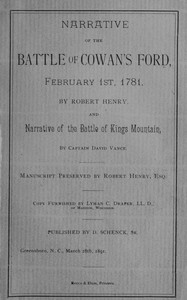
Narrative of the Battle of Cowan's Ford, February 1st, 1781 and Narrative of the Battle of Kings Mountain — A Closer Reading
283
3
Project Gutenberg
2015
United States -- History -- Revolution, 1775-1783 -- Campaigns; Cowan's Ford, Battle of, N.C., 1781; King's Mountain, Battle of, S.C., 1780
Readers of public-domain and historical texts
Project Gutenberg digital edition
en
Edition facts
Words: 17,996
Reading time: 79 min
Text sections: 7
Source:
Project Gutenberg record #50137
Robert Henry's firsthand account of Cowan's Ford and David Vance's narrative of Kings Mountain, written decades later, reveal distinct authorial choices in diction, voice, and structure that shape their testimony of Revolutionary battles.
Editorial Edition Score
4.5/5
★★★★★
★★★★★
Calculated from edition completeness, EPUB availability, text structure and catalogue metadata. Not a user rating.
Edition quality
Robert Henry, writing decades after the events, opens his narrative of Cowan's Ford with a preface that situates his manuscript within a chain of preservation: copied by Lyman Draper from an original held by Dr. Hardy, who received it from Henry's son. This layered provenance immediately signals that the text is not raw memory but a mediated document. Henry's voice is that of a veteran turned historian, blending personal recollection with sweeping strategic analysis. He describes the period before Kings Mountain as 'the most disastrous period for Liberty and Independence,' using metaphors like 'shrouded in Egyptian darkness' to convey despair. His diction oscillates between plain report—'we had no army'—and vivid imagery, such as Cornwallis 'panic-struck' by the 'gaffs and spurs of the blue hens’ chickens.' These choices reveal a narrator who is both participant and moral commentator.
Voice and Perspective: The Veteran as Historian
Henry writes as a survivor who fought at Kings Mountain, yet his narrative adopts an omniscient tone when assessing British strategy. He lists enemy commanders—'Cornwallis was in Charlotte... Rawdon in Camden... Leslie at Winnsborough'—with the detachment of a staff officer. But his language turns visceral when describing Tory plunderers: 'squads of petty-larceny plunderers, who were raised from poverty to affluence in a few days.' The phrase 'petty-larceny' is a legal term, suggesting Henry's later training as a lawyer. His voice blends the concrete details of a witness with the analytical framework of a historian, a duality that shapes the narrative's authority.
Diction of Desperation and Triumph
Henry's word choices create a stark emotional arc. He calls the pre-Kings Mountain period 'Egyptian darkness,' a biblical allusion that frames the patriot cause as a people in bondage. The turning point is described with agricultural metaphors: Cornwallis feared 'the gaffs and spurs of the blue hens’ chickens'—a folk expression for fierce fighters. This colloquialism contrasts with the formal 'precipitate retrograde march' that follows. Henry's diction shifts from elevated despair to earthy triumph, mirroring the narrative's movement from crisis to victory. He insists his 'statement of facts... cannot be contradicted or denied,' a rhetorical claim that underscores his desire to fix the record.
Structure and Emphasis: The Battle as Pivot
Henry structures his narrative around a single turning point: Ferguson's defeat. He devotes substantial space to the strategic situation before the battle, enumerating British forces in a list-like passage that builds a sense of encirclement. The sentence 'This was the most disastrous period for Liberty and Independence' is followed by a single, emphatic paragraph: 'Ferguson’s defeat was the turning point in American affairs.' The brevity of that statement, set against the preceding density, gives it rhetorical weight. Henry then traces the consequences—Cornwallis's retreat, the scattering of Tory bands—in a cascade of cause and effect. This structure privileges the battle as a hinge of history, not merely a local engagement.
Recurring Details: Horses, Counterfeit Money, and Plunder
Henry repeatedly notes material details that ground his account in the physical realities of war. He observes that after Charleston fell, the British 'deluged the country with Counterfeit Continental bills' to buy horses from Whigs. This detail—economic warfare through forgery—appears alongside lists of plundered property. The phrase 'the last piece of whig property they could lay their hands on' suggests a methodical destruction. Henry also names specific plunderers: 'George Lumpkin, Ben. Moore and others in Lincoln county, the chief of plunderers.' These recurring references to theft and currency manipulation reveal a narrator attentive to the economic dimensions of conflict, perhaps reflecting his own experience as a landowner and lawyer.
Readers should note that Henry's narrative is not a neutral record but a crafted argument, shaped by his later perspective and rhetorical goals. His use of biblical allusion, legal terminology, and folk metaphor creates a distinctive voice that blends personal witness with historical judgment. Comparing his account with Vance's shorter narrative of Kings Mountain may illuminate how different authors—one a participant, the other a contemporary—chose to frame the same events. The text rewards attention to its diction and structure, which reveal as much about the writer as about the battles he describes.
Reader reflection
How will you remember this book?
Save your reaction, strongest insight, and memorable passage.
Your progress
0
/
10
2
How much did you enjoy the reading experience?
3
Would you recommend this book to another reader?
4
What was the reading difficulty like?
5
Did this book create an emotional response?
6
Do you expect to return to this book?
7
How original did the book feel?
8
What was the strongest part of the book?
9
What is the main idea you are taking away?
10