1

Notes of a Private — Story, Setting & Ideas
376
2
Project Gutenberg
2015
United States -- History -- Civil War, 1861-1865 -- Personal narratives, Confederate; Confederate States of America. Army. Tennessee Cavalry Regiment, 7th
Readers of public-domain and historical texts
Project Gutenberg digital edition
en
Edition facts
Words: 48,149
Reading time: 210 min
Text sections: 5
Source:
Project Gutenberg record #49466
A Confederate private's memoir of service in the 7th Tennessee Cavalry under Forrest, based on memory and observation, covering battles from Brice's Cross Roads to the war's end, with tactical reflections and personal vignettes.
Editorial Edition Score
4.7/5
★★★★★
★★★★★
Calculated from edition completeness, EPUB availability, text structure and catalogue metadata. Not a user rating.
Edition quality
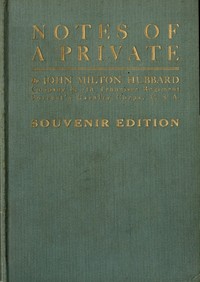
John Milton Hubbard, a private in Company E, 7th Tennessee Cavalry, wrote this memoir relying almost entirely on his own memory. The book opens with a dedication to Southern soldiers who served to the bitter end, and includes his parole signed at Gainesville, Alabama, on May 11, 1865. Hubbard explicitly states he served the entire war, traveling through five states under many different generals, and claims few privates had better opportunities for observation.
Memory as Method
Hubbard's preface declares he relied "almost entirely on his own memory" for the reminiscences, sketches, and portraitures in the book. This is not a compiled history but a personal record, and he emphasizes his vantage point as a private soldier. The excerpts show him weaving together tactical description—such as the use of double-shotted canister at Brice's Cross Roads—with intimate details like the death of Isaac H. Pipkin, a fellow soldier who had remarked that morning that if killed, he wished to be "put away decently." Hubbard's account of finding Pipkin's body after a charge reveals how personal loss punctuates the narrative. The memoir thus balances broad battle movements with the fates of individuals, a method that gives the work its particular texture.
Forrest's Tactics Through a Private's Eyes
Hubbard offers pointed observations on General Nathan Bedford Forrest's command style. At Brice's Cross Roads, he notes that Forrest "had put into practice his favorite tactics" of launching his entire command into action immediately, without reliance on reserves. Hubbard writes that Forrest's cavalry "never looked around for reserves, but confidently expected to do the work themselves." This is not a general's after-action report but a soldier's view of how those orders felt in execution. Hubbard also includes a comparative force analysis, claiming 3,200 Confederates faced 8,700 Federals, and lists captured matériel: over two hundred wagons, thirty ambulances, twenty-one caissons. The inclusion of such numbers suggests Hubbard kept or reconstructed a detailed mental ledger of the campaign.
The Language of a Confederate Veteran
The excerpts reveal a distinctive voice. Hubbard refers to the U.S. Colored Troops as a "negro brigade" and describes them as "deluded creatures" who threw away their badges and took to the woods. He mentions their war cry of "Remember Fort Pillow," showing that the phrase circulated among Confederate soldiers as a taunt. His dedication addresses "those Southern soldiers who, regardless of their sentiments as to the abstract right of secession" went into the army at the behest of an overwhelming majority—a formulation that distances the soldier from political justification while affirming loyalty. The epigraphs from Tacitus and Virgil signal a classical framing, and the Latin motto "Nihil scriptum miraculi causa" (Nothing written for the sake of wonder) suggests Hubbard aimed for plain testimony rather than sensationalism.
Structure and Scope
The table of contents shows twelve chapters plus an appendix containing Forrest's farewell address and a note on the Forrest equestrian statue. Chapters cover mustering in, service in five states, specific battles (Davis' Bridge, Corinth, Holly Springs, Brice's Cross Roads, Harrisburg, the Memphis Raid), and Hood's expedition. The final chapter is titled "Conclusion." This organization follows a chronological campaign narrative, but Hubbard intersperses "personals and portraitures" in a dedicated chapter, indicating he deliberately set aside space for character sketches. The appendix material suggests the book also served as a memorial vehicle for Forrest's legacy.
Readers should approach Notes of a Private as a firsthand account filtered through memory and written decades after the events. Hubbard's explicit reliance on his own recollection, his inclusion of casualty figures, and his tactical commentary all invite scrutiny. The book is valuable for its specific details about daily life in Forrest's cavalry and for the perspective of an enlisted man who nonetheless felt entitled to assess generalship. Those interested in the social attitudes of Confederate veterans will find the language and framing as revealing as the battle narratives.
Reader reflection
Your personal reading reflection
Build a private reading journal entry for this title.
Your progress
0
/
10
2
Did this book hold your interest?
3
Would you pass this book on to a friend?
4
What was the reading difficulty like?
5
Was the book moving at the right speed?
6
Did anything about the book feel genuinely new?
7
Did any part of the book feel personally relevant?
8
Would you read this book again?
9
In one sentence, what did you learn?
10