1

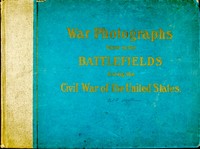
Original Photographs Taken on the Battlefields during the Civil War of the United States — Reading Companion
674
3
Project Gutenberg
2013
United States -- History -- Civil War, 1861-1865 -- Campaigns; United States -- History -- Civil War, 1861-1865 -- Pictorial works
Readers of public-domain and historical texts
Project Gutenberg digital edition
en
Edition facts
Words: 66,968
Reading time: 292 min
Text sections: 13
Source:
Project Gutenberg record #43922
A 1907 album of Civil War photographs by Brady and Gardner, compiled by Edward Bailey Eaton, with captions and narrative by Francis Trevelyan Miller. The excerpts show the collection's origin story, technical challenges, and specific naval operations like the Fort Fisher assault.
Editorial Edition Score
4.8/5
★★★★★
★★★★★
Calculated from edition completeness, EPUB availability, text structure and catalogue metadata. Not a user rating.
Edition quality
The 1907 album Original Photographs Taken on the Battlefields during the Civil War of the United States presents itself as a recovered treasure: negatives stored for more than forty years, valued at $150,000, and offered for three dollars per copy. The compiler, Edward Bailey Eaton, and the narrative author, Francis Trevelyan Miller, emphasize that the collection was unknown to the public and that even eminent photographers and distinguished veterans doubted such photography existed during the war. This framing—part salesmanship, part historical rescue—shapes how the images are introduced.
Claims of Rarity and Skepticism
The opening pages assert that this is “the most valuable collection of historic photographs in America” and “the first time that the camera was used so extensively and practically on the battle-field.” Miller reports that while the book was in preparation, “eminent photographers have pronounced it impossible,” and “distinguished veterans of the Civil War have informed me that they knew positively that there were no cameras in the wake of the army.” These statements serve a dual purpose: they authenticate the collection by noting the disbelief it overcame, and they position the album as a corrective to common knowledge. The catalog subjects list the work under “United States – History – Civil War, 1861-1865 – Campaigns” and “Pictorial works,” but the excerpts reveal that the text is as much about the photographs’ provenance and the obstacles to their creation as about the battles themselves.
The Fort Fisher Narrative: A Case Study
The extended account of the Fort Fisher expedition (January 1865) illustrates how the album blends photographic documentation with battle history. The text describes the fleet assembling, the ironclads opening fire, and the sailors landing “packed like sheep in a death pen, under a most galling fire.” Casualty figures are given: 309 in the fleet, 110 killed and 536 wounded in Terry’s command. The photograph of the fleet is said to have been “secured under much difficulty.” This section also includes a portrait of Admiral David D. Porter and staff on the flagship Malvern, and a panoramic view of Fort Fisher. The narrative treats the images as evidence of specific moments—the fleet before the attack, the commanders on deck—while the surrounding prose supplies context that the single frame cannot convey.
Naval Transformation and the Photographer’s Role
A separate passage discusses the Civil War as “a great practical demonstration of naval vessels propelled by steam,” noting the shift from sail to steam, the introduction of ironclads and torpedoes, and the Navy’s expansion from 90 vessels to nearly 600. The photographers are said to have “secured a large number of negatives during naval demonstrations” toward the war’s close. This section positions the images not merely as records of ships and men but as documents of technological change. The catalog subject “Campaigns” is thus supplemented by a technological and logistical narrative that the photographs themselves only partially show. The album’s text, written by Miller, does the work of connecting the static images to broader historical forces.
Readers should approach this album as a hybrid artifact: part photographic collection, part historical narrative, part promotional document. The captions and essays often tell as much about the difficulty of making the images as about the events depicted. The excerpts do not reveal how many photographs are included or how they are arranged, but they make clear that the compiler and author intended to prove that battlefield photography existed—and mattered.
Reader reflection
Take a moment to reflect on this book
Create a short personal record of your experience with this book.
Your progress
0
/
10
2
Was reading this book enjoyable?
3
Would you recommend this book to another reader?
4
What was the reading difficulty like?
5
Which element worked best for you?
6
Was the book what you thought it would be?
7
How valuable was this book for your own interests?
8
Did this book create an emotional response?
9
What did this book teach you most?
10