1

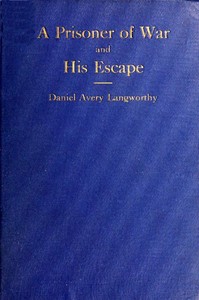
Reminiscences of a Prisoner of War and His Escape — A Reader’s Guide
8
3
Project Gutenberg
2014
United States -- History -- Civil War, 1861-1865 -- Prisoners and prisons; United States -- History -- Civil War, 1861-1865 -- Personal narratives
Readers of public-domain and historical texts
Project Gutenberg digital edition
en
Edition facts
Words: 17,355
Reading time: 76 min
Text sections: 2
Source:
Project Gutenberg record #44702
A Civil War memoir by Daniel Avery Langworthy, recounting his capture, imprisonment, and escape from Confederate camps, structured around tense nocturnal movements and reliance on Unionist guides.
Editorial Edition Score
4.5/5
★★★★★
★★★★★
Calculated from edition completeness, EPUB availability, text structure and catalogue metadata. Not a user rating.
Edition quality
Daniel Avery Langworthy’s Reminiscences of a Prisoner of War and His Escape opens with a domestic scene: his sister Sarah demands the full story of his captivity and escape. That oral impulse shapes the narrative—Langworthy writes decades later, from memory, without a diary. The result is a spare, episodic account that moves through a series of tight spots, each resolved by a guide, a whispered warning, or a risky decision. The book’s structure mirrors the escape itself: a sequence of constrained spaces—prison camps, boxcars, mountain hideouts—punctuated by sudden movements through darkness.
A Narrative Built on Tight Spots
The phrase “tight place” recurs throughout the memoir, signaling moments when Langworthy and his companions are cornered by guerrillas, guards, or geography. These episodes follow a pattern: the party halts, assesses, and dispatches a scout—often the resourceful Hastings—who returns with intelligence. The scout’s report triggers a nocturnal movement, usually guided by a local Union sympathizer. Langworthy’s prose mirrors this rhythm: short declarative sentences, abrupt shifts from description to action. For example, when Hastings approaches a cabin, the woman’s first words are “Mister, this a very bad place for you uns.” The dialogue is terse, functional. Langworthy does not embellish; he records the exchange as it likely happened, preserving the urgency of the moment.
Guides, Signals, and Silent Codes
Langworthy’s escape depends on a network of helpers—enslaved and free Black people, Unionist farmers, and even a blacksmith. These figures appear suddenly, speak plainly, and vanish. The guide who leads them past a guerrilla camp moves “through a gate into a back yard” and past a log stable where horses are being tended. Langworthy notes the light between the logs, the sight of men caring for horses. The guide’s instructions are precise: “When you come to four corners, a signboard and a schoolhouse there is the line between North and South Carolina.” The memoir treats these directions as sacred text. Langworthy’s attention to such details—the signboard, the schoolhouse, the blacksmith shop—turns the landscape into a map of danger and deliverance.
Memory Without a Diary
Langworthy acknowledges the limits of his recollection: “Doubtless I could have told this story better fifty years ago.” Written in 1915, the memoir relies on what he calls “a fixed impression on my mind.” This distance shapes the narrative’s texture. Specific moments—the sight of a light shining across a road, the feel of Captain Aldrich’s heartbeat through his arm—stand out against a background of generalized movement. Langworthy does not reconstruct dialogue verbatim; he reports the gist. The result is a story that feels both immediate and filtered, as if the author is still puzzling over what happened. The preface’s framing—his sister’s demand for the story—suggests that the act of telling is itself an attempt to fix memory in place.
Objects as Evidence
The illustrations listed in the front matter hint at the memoir’s material preoccupations: a compass, knife, fork, and spoon “used in Capt. Langworthy’s escape”; shoes and a hickory stick. These objects are not described in the excerpt, but their inclusion signals that Langworthy thinks of his escape as a physical ordeal, measured in tools and footwear. The narrative itself is studded with concrete details: the log stable with lights between the logs, the rain and thick brush during the night march, the blacksmith shop with no light in the house. These details anchor the story in sensory experience. Langworthy does not explain their significance; he trusts that the reader will understand why a light across a road or a woman’s warning matters.
Langworthy’s memoir is best read as a series of tactical problems solved by patience and local knowledge. The narrative does not offer a grand arc of suffering and triumph; it moves from one tight spot to the next, each resolved by a guide or a gamble. Readers should attend to the small decisions—when to hide, when to speak, whom to trust—that structure the escape. The book’s value lies not in its literary polish but in its fidelity to the logic of flight.
Reader reflection
What was your reading experience?
Capture what you thought, learned, and would like to remember.
Your progress
0
/
10
2
Was reading this book enjoyable?
3
Would you pass this book on to a friend?
4
How demanding did the text feel?
5
Did it raise ideas you would like to talk about?
6
Could you follow the author’s main argument?
7
What did you appreciate most?
8
How did the reading compare with what you expected?
9
What is the main idea you are taking away?
10