1

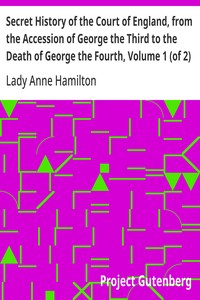
Secret History of the Court of England, from the Accession of George the Third to the Death of George the Fourth, Volume 1 (of 2) Including, Among Other Important Matters — Text and Context
(0 User reviews)
111
Project Gutenberg
2011
Not confirmed
Great Britain -- History -- 1714-1837; Great Britain -- Court and courtiers -- History -- 18th century; Great Britain -- Court and courtiers -- History -- 19th century; George III, King of Great Britain, 1738-1820 -- Relations with courts and courtiers; George IV, King of Great Britain, 1762-1830 -- Relations with courts and courtiers; Caroline, Queen, consort of George IV, King of Great Britain, 1768-1821
Readers of public-domain and historical texts
Project Gutenberg digital edition
en
Edition facts
Words
103,310
Reading time
450 min
Text sections
12
For Secret History of the Court of England, from the Accession of George the Third to the Death of George the Fourth, Volume 1 (of 2) Including, Among Other Important Matters — Text and Context, the stored edition analysis reports 103,310 words, 7 hr 30 min estimated reading time, and 12 detected text sections.
The text analysis averages about 26.4 words per sentence, while the detected sections provide another way to judge how the source is divided.
Project Gutenberg metadata also associates the work with “Great Britain -- History -- 1714-1837,” connecting these edition facts with the source record’s subject description.
Source:
Project Gutenberg record #37570
Lady Anne Hamilton's 1832 exposé of George III and George IV's courts, using firsthand knowledge to detail corruption, royal debts, and the mysterious death of Princess Charlotte, with a missing first 24 pages due to libel accusations.
Editorial Edition Score
4.9/5
★★★★★
★★★★★
Calculated from edition completeness, EPUB availability, text structure and catalogue metadata. Not a user rating.
How this score is calculated
- Description quality20 pts
- Title & short description10 pts
- Source metadata20 pts
- Text length15 pts
- Chapters / structure15 pts
- EPUB file integrity20 pts
Total of 100 points, scaled to a 2.5-5.0 range. Editions with an empty description or a missing EPUB file are not scored.
Edition quality
Public-domain source text
Read the source text
The source text is kept in the dedicated reader, separate from this catalogue record and its commentary.
Lady Anne Hamilton opens her 1832 Secret History with a direct address to the reader, asserting that her high social position—sister of the Duke of Hamilton—guarantees the truth of the facts she presents. The work is framed as a moral mirror for the great, a warning to statesmen about perverted justice, and a revelation for the humble about courtly deception. The original printing was disrupted by a libel accusation, forcing the rewriting and omission of the first 24 pages, a fact noted by the transcriber. This missing material likely contained the most incendiary claims, setting a tone of suppressed truth that pervades the surviving text.
A Voice of Moral Indignation
The excerpts reveal a narrator who does not feign neutrality. Hamilton employs the language of a prosecutor, calling the Prince Regent’s actions “wicked” and accusing him of having “relinquished Justice, and abandoned Mercy.” She describes the royal brothers’ bonds to the Parisian firm Perigoux and Co. as a scheme where they “undertook to pay more than their means would ever permit,” and she hints at “LIVES SACRIFICED” to preserve their reputations. This moral fervor is not confined to royalty; she condemns the grant of £100,000 to Lord Wellington as payment for “legal slaughter” and contrasts it with the neglect of “perishing millions.” The reader should expect a partisan account, one that wears its outrage openly and uses court insider knowledge to indict the powerful.
Structure and the Missing Pages
The surviving text begins after page 24, which were never printed due to libel concerns. This lacuna shapes the reading experience: the narrative starts mid-stream, without the original preface or early accusations. The transcriber notes that the original used two types of blockquotes, one with smaller font and another with extra white space, suggesting a careful visual hierarchy for quoted material. Hamilton’s prose mixes parliamentary detail—such as Vansittart’s budget of over sixty-two million pounds—with dramatic apostrophes, like her address to “thy perfume” that “spreads desolation to society.” This blend of dry financial record and fiery rhetoric creates an uneven rhythm, where cold numbers suddenly give way to emotional outbursts. Readers should watch for these shifts as clues to Hamilton’s rhetorical strategy.
Recurring Targets: Debt and Deception
Two themes dominate the excerpts: royal indebtedness and the systematic deception of the public. Hamilton repeatedly returns to the bonds given by Princes George, Frederick, and William to Perigoux and Co., calling them “several hundred thousand pounds” that the princes could never repay. She reports that the Princess of Wales, in conversation with Whitbread and Perceval, claimed the princes “deserve severe exposure” and that their “action was not only wicked, but their intention also.” The second theme is the suppression of truth: the Prince Regent commands Lord Liverpool never to hint at “matters so very disagreeable to the royal ear,” and Hamilton warns that any patriot who proposed relief for the poor would be “consigned to a damp and dreary dungeon.” These patterns suggest that the full volume likely builds a case that court secrecy enabled financial and moral corruption.
The Princess of Wales as a Source
One of the most striking features of the excerpts is Hamilton’s reliance on the Princess of Wales (Caroline of Brunswick) as a direct source. The princess is quoted in “open and friendly conversation” with political figures, revealing details of the royal bonds and hinting at lives lost to protect the princes’ reputations. This positions Caroline as a whistleblower within the text, lending credibility to Hamilton’s claims. However, the excerpts do not reveal how Hamilton obtained these conversations or whether Caroline authorized their publication. Given the libel accusation that forced the book’s revision, readers should treat these reported speeches as potentially contested evidence. The princess’s own fraught history with George IV adds a layer of personal vendetta to the narrative, which Hamilton does not explicitly acknowledge but which colors every accusation.
Because the first 24 pages are missing, readers begin this volume in medias res, without the author’s original framing. It is advisable to read the preface and any surviving front matter from the second volume (also available from Project Gutenberg) to recover Hamilton’s stated intentions. Pay close attention to the footnotes and the transcriber’s notes, which document textual anomalies that may signal places where the libel accusation forced changes. This is not a dispassionate history but a polemic by a well-connected insider; its value lies less in factual accuracy than in the vivid picture it paints of court faction and the risks of speaking truth to power.
Reading how Lady Anne’s missing pages left the scandal half-told, I remembered dog-earing an old biography in my grandmother’s study, its spine cracked exactly there where a chapter stopped mid-sentence. That same ache of interruption returned here. The Secret History of the Court of England, from the Accession of George the Third to the Death of George the Fourth, Volume 2 (of 2) Including, Among Other Important — Inside the Classic felt like finding that missing chapter finally tucked safe between later pages, quiet relief settling beside the old curiosity.
There are no reviews for this eBook.
There are no comments for this eBook.
Reader reflection
What was your reading experience?
Capture what you thought, learned, and would like to remember.
Your progress
0
/
10
2
Was reading this book enjoyable?
3
Would you recommend this book to another reader?
4
How demanding did the text feel?
5
How did the reading compare with what you expected?
6
Do you expect to return to this book?
7
Was the book moving at the right speed?
8
How original did the book feel?
9
What is the main idea you are taking away?
10