1

Sketches of the War A Series of Letters to the North Moore Street School of New York — Themes and Context
1823
6
Project Gutenberg
2019
United States -- History -- Civil War, 1861-1865 -- Personal narratives; United States. Army. Iowa Cavalry Regiment, 5th (1861-1865)
Readers of public-domain and historical texts
Project Gutenberg digital edition
en
Edition facts
Words: 50,118
Reading time: 218 min
Text sections: 5
Source:
Project Gutenberg record #60629
Captain Charles C. Nott's letters to New York schoolchildren, written from the field, blend Civil War reporting with linguistic observations and precise details of soldier life, foraging, and encounters with Southern civilians and enslaved people.
Editorial Edition Score
4.7/5
★★★★★
★★★★★
Calculated from edition completeness, EPUB availability, text structure and catalogue metadata. Not a user rating.
Edition quality
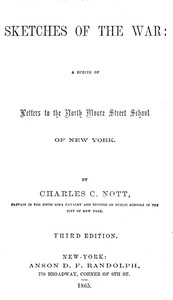
Charles C. Nott, a captain in the Fifth Iowa Cavalry and a New York City school trustee, wrote these letters to the students of North Moore Street School while serving in the Civil War. The preface to the second edition explains his deliberate avoidance of "baby-talk" and his aim to write with the "severe purity of English composition" that made adult classics like Robinson Crusoe enduring children's literature. The letters were composed amid the scenes they describe, giving them an immediacy that adult readers may also appreciate.
Language Observed in the Field
Nott pays close attention to the speech of Southern civilians, noting that they use "many old English words and phrases—some odd and obsolete, and some better and more correct than our own." He provides examples: instead of "get down," they say "alight"; instead of "How early did you get up this morning?" they ask "How early did you arise?"; relatives are called "kinfolk"; the well-dressed are "well clad"; a horse-path is a "bridle-road"; a brook is a "branch" and a stream a "fork." One man complimented a soldier as "the most chirk young fellow in the regiment," and a young lady praised her horse by saying it "couldn't tote double." These observations are woven into the narrative, not presented as a glossary, and they reveal Nott's interest in regional dialect as a marker of cultural difference.
Encounters on the March
The excerpts show Nott describing a foraging stop at a house belonging to a Confederate lieutenant. The scene is rendered with specific, unembellished details: three "contrabands" (escaped slaves) swing open a gate; a young mulatto woman with a "sad, intelligent face" reports that her mistress does not stay there nights. When Nott asks about provisions, she directs him to the stores. Later, a black boy on a horse drives two mules at a gallop, explaining that the mules "likes" the evening run after plowing all day. These moments are presented without editorial comment, allowing the reader to observe the dynamics of military occupation and the resilience of enslaved people.
Structure and Audience
The letters are addressed to schoolchildren, but Nott avoids condescension. He writes in a direct, conversational style, often using present tense to create immediacy: "But while I am telling you this we have come out on the Paris road, and have turned toward the Holly Fork." The narrative moves through a series of titled sketches—"The Hospital," "Donelson," "Foraging," "A Flag of Truce"—each a self-contained episode. The preface explicitly compares the work to Robinson Crusoe and Gulliver's Travels, arguing that the best children's literature was written for adults. This framing suggests that Nott intended the letters to be both instructive for young readers and engaging for any audience.
Readers should approach Sketches of the War as a series of discrete vignettes rather than a continuous memoir. Nott's attention to language, his matter-of-fact recording of daily encounters, and his avoidance of heroic rhetoric make the letters a distinctive primary source. The gaps in the excerpts—such as the full context of the assault or the flag-of-truce episode—invite curiosity about what the complete letters contain.
Reader reflection
How will you remember this book?
Save your reaction, strongest insight, and memorable passage.
Your progress
0
/
10
2
Was reading this book enjoyable?
3
Would you recommend this book to another reader?
4
What was the reading difficulty like?
5
Did any part of the book feel personally relevant?
6
How much did the book move you?
7
How useful did the reading feel?
8
How did the reading compare with what you expected?
9
In one sentence, what did you learn?
10