1

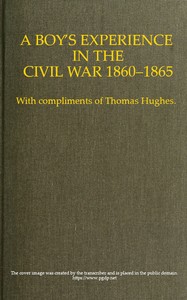
A Boy's Experience in the Civil War, 1860-1865 — A Reader’s Guide
(0 User reviews)
2003
Project Gutenberg
2020
Not confirmed
United States -- History -- Civil War, 1861-1865 -- Personal narratives, Confederate
Readers of public-domain and historical texts
Project Gutenberg digital edition
en
Edition facts
Words
22,641
Reading time
99 min
Text sections
2
The catalog record for A Boy's Experience in the Civil War, 1860-1865 — A Reader’s Guide provides practical reading context through 22,641 words, 1 hr 39 min estimated reading time, and 2 detected text sections.
The text analysis averages about 29.6 words per sentence, while the detected sections provide another way to judge how the source is divided.
Project Gutenberg metadata also associates the work with “United States -- History -- Civil War, 1861-1865 -- Personal narratives, Confederate,” connecting these edition facts with the source record’s subject description.
Source:
Project Gutenberg record #62271
Thomas Hughes recounts his boyhood in Virginia during the Civil War, focusing on his father's imprisonment, a journey through Union lines, and firsthand observations of Richmond's evacuation and looting.
Editorial Edition Score
4.5/5
★★★★★
★★★★★
Calculated from edition completeness, EPUB availability, text structure and catalogue metadata. Not a user rating.
How this score is calculated
- Description quality20 pts
- Title & short description10 pts
- Source metadata20 pts
- Text length15 pts
- Chapters / structure15 pts
- EPUB file integrity20 pts
Total of 100 points, scaled to a 2.5-5.0 range. Editions with an empty description or a missing EPUB file are not scored.
Edition quality
Public-domain source text
Read the source text
The source text is kept in the dedicated reader, separate from this catalogue record and its commentary.
Thomas Hughes, born in 1850, was a Virginia boy when the Civil War began. His memoir, published in 1904, opens not with battles but with his father's arrest as a political prisoner for refusing the oath of allegiance to the United States. The narrative follows Hughes through a flag-of-truce journey to Richmond, a summer on the James River, and the chaotic final days of the Confederacy. The excerpts show a young witness to adult conflicts—his father's exchange orchestrated through a former medical instructor, the mundane details of canal boat travel, and the surreal spectacle of women fighting over a bolt of cloth while the city burns. Hughes writes with a boy's eye for peculiar incidents, not strategic overviews.
A Political Prisoner's Son
The memoir’s first extended episode centers on Hughes’s father, a physician and controversal writer who “furthered by writing and personal work the adoption of the ordinance of secession.” When Virginia seceded, he declined the federal oath and was sent to Camp Chase in Ohio. Hughes records the nine-month imprisonment and the father’s resourceful escape: learning that a fellow prisoner’s brother was a Union captive, he wrote to his old professor Dr. Pancost of Philadelphia, arranging a special exchange. The account is precise about logistics—the route via Baltimore, Fortress Monroe, City Point, Petersburg, to Richmond—and about the family’s accommodation at the Eutaw House, where they waited in a crowded parlor until a room overlooking the court became available. The father’s medical training and personal connections directly shaped the boy’s war experience.
Canal Boats and Confederate Passes
In 1863, Hughes obtained a pass from General Winder’s son and boarded a canal boat on the James River and Kanawha Canal. His description dwells on the boat’s workings: three horses at a rapid trot, a driver blowing a horn for locks and mail, passengers ducking at cries of “low bridge,” and the long saloon with seats converted into beds at night. He notes that freight boat drivers played artistic horn calls, while the boy on the passenger boat never attempted such music. The passage is notable for its quiet, observational tone—no battle scenes, only the routine of travel under Confederate authority. Hughes’s focus on the physical details of the journey, from the kitchen at the boat’s end to the camp stools on top, grounds the narrative in a child’s sensory world.
The Burning of Richmond
The most vivid excerpt describes Richmond’s evacuation. Hughes, returning home, went to the Spotswood Hotel at 8th and Main streets, where a fire raged. He could not understand why Confederate troops had set the blaze. The post office, a granite building housing President Davis’s office, was the only structure left standing. Looting erupted: women, men, and boys rolled away barrels of flour and bolts of cloth. A half-dozen women fought over a single bolt of unbleached coarse cotton, unwinding it as each pulled her way. Hughes and another boy pelted them with tobacco from barrels. Soon shells from an arsenal began to burst, scattering the crowd. The scene is chaotic, specific, and morally ambiguous—a boy’s prank amid destruction, with no clear heroes or villains.
Hughes’s memoir is less a history of the war than a record of its domestic and incidental textures. Readers will find no grand strategy or battle narratives, but rather the perspective of a boy who observed his father’s imprisonment, traveled under Confederate passes, and watched Richmond burn. The catalog subjects classify it as a Confederate personal narrative, yet the excerpts resist easy partisanship: Hughes notes the looting by all sides and the absurdity of the cloth fight. Approach the text as a document of civilian life and a young person’s encounter with war’s disorder.
There are moments in Hughes’s account, waiting for news of his father, that feel almost too quiet to bear. I found myself thinking how war camps always hold that same hush between terrors, soldiers just living their ordinary days. That’s what A Study of Army Camp Life during American Revolution — Edition Insights captures—the unremarkable breathing between the battles we remember.
There are no reviews for this eBook.
There are no comments for this eBook.
Reader reflection
How will you remember this book?
Save your reaction, strongest insight, and memorable passage.
Your progress
0
/
10
2
Was reading this book enjoyable?
3
Is this a title you would suggest to others?
4
How easy was the book to follow?
5
Which element worked best for you?
6
How did the reading compare with what you expected?
7
How did the pace of the book feel?
8
How useful did the reading feel?
9
What is the main idea you are taking away?
10