1

A Study of Army Camp Life during American Revolution — Edition Insights
(0 User reviews)
635
Project Gutenberg
2017
Not confirmed
United States -- Armed Forces -- Military life; United States -- History -- Revolution, 1775-1783 -- American forces
Readers of public-domain and historical texts
Project Gutenberg digital edition
en
Edition facts
Words
19,999
Reading time
87 min
Text sections
11
Before opening A Study of Army Camp Life during American Revolution — Edition Insights, the edition data offers a quick orientation: 19,999 words, 1 hr 27 min estimated reading time, and 11 detected text sections.
The text analysis averages about 18.4 words per sentence, while the detected sections provide another way to judge how the source is divided.
Project Gutenberg metadata also associates the work with “United States -- Armed Forces -- Military life,” connecting these edition facts with the source record’s subject description.
Source:
Project Gutenberg record #55957
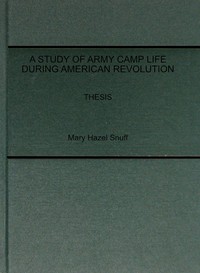
This editorial note examines how Mary Hazel Snuff's 1918 master's thesis uses diaries, orderly books, and journals to reconstruct the daily realities of Revolutionary War soldiers, focusing on the gap between official regulations and actual camp conditions.
Editorial Edition Score
4.7/5
★★★★★
★★★★★
Calculated from edition completeness, EPUB availability, text structure and catalogue metadata. Not a user rating.
How this score is calculated
- Description quality20 pts
- Title & short description10 pts
- Source metadata20 pts
- Text length15 pts
- Chapters / structure15 pts
- EPUB file integrity20 pts
Total of 100 points, scaled to a 2.5-5.0 range. Editions with an empty description or a missing EPUB file are not scored.
Edition quality
Public-domain source text
Read the source text
The source text is kept in the dedicated reader, separate from this catalogue record and its commentary.
Mary Hazel Snuff's 1918 master's thesis, A Study of Army Camp Life during American Revolution, opens with a clear methodological aim: to draw a picture of the private soldier "as he lived, ate, was punished, played, and worshiped in the army camp." Snuff distinguishes her work from top-down histories by emphasizing the gap between congressional rules and what actually happened—"not what was intended, but what happened." The introduction signals a reliance on primary sources: letters, journals, orderly books, and diaries, though Snuff notes the difficulty of finding unedited diaries of privates, as published versions often emphasize military operations over social conditions. This framing prepares the reader for a study grounded in documentary evidence rather than narrative synthesis.
Housing, Food, and the Gap Between Orders and Reality
The first two chapters, on housing and food/clothing, establish a recurring pattern: official regulations often bore little relation to soldiers' experiences. Snuff draws on orderly books and journals to show that while Congress set rations and Washington issued orders about huts and sanitation, shortages of materials, transportation failures, and weather frequently undermined them. For instance, the excerpts mention that "the opportunities for obeying those orders were not always the best." A reader should note how Snuff uses specific diary entries—such as those recording meals of potatoes with beech-nuts for dessert—to illustrate the improvisation that scarcity forced. The thesis does not linger on famous hardships like Valley Forge alone; it treats them as part of a broader, systemic problem.
Health, Sanitation, and the Body in Camp
Chapter III, on health and sanitation, continues the theme of institutional intention versus lived reality. Snuff's evidence from journals and orderly books points to frequent outbreaks of disease, inadequate hospital facilities, and the difficulty of enforcing cleanliness among troops. The thesis likely examines how camp layout, waste disposal, and water supply affected sickness rates. A reader should watch for how Snuff balances quantitative data (e.g., numbers of sick reported) with qualitative accounts from soldiers' own writings. The emphasis is on the soldier's physical experience—what it meant to be ill or injured in a camp where medical knowledge was limited and supplies erratic. This section grounds the study in material conditions rather than abstract policy.
Recreation and the Social Fabric of Camp
Chapter IV, on recreation, offers some of the most vivid excerpts. Snuff describes officers' dances, dinners, sleighing parties, and even a "little dance" at General Greene's quarters where Washington danced three hours without sitting down. But she also notes that recreation was often improvised: "Some of the practices would hardly be classed as recreation, but they helped to break the monotony." The chapter includes accounts of subscription balls in commissary storehouses, with Washington in black velvet and foreign commanders in gold lace. Yet Snuff does not ignore the rank-and-file; she mentions games of ball and even watching punishments as forms of diversion. The reader should note how Snuff uses these details to argue that recreation was a response to need rather than a pre-planned institution.
Religion, Duty, and the Limits of the Source Base
The final chapters on religion and camp duties/discipline round out the study. Snuff's treatment of religion likely draws on chaplains' records and soldiers' journals to show how worship services were conducted amid campaigning. The discipline chapter probably examines courts-martial, punishments, and the enforcement of orders. Throughout, Snuff is candid about the limitations of her sources: she notes the scarcity of private soldiers' diaries and the editing that prioritized military operations. A reader should observe how Snuff handles this gap—she does not claim to have a complete picture but instead builds her analysis from what survives. The bibliography, listing primary sources like orderly books and journals, underscores the thesis's archival foundation.
Snuff's study is best read as a documentary mosaic rather than a continuous narrative. The reader should attend to the footnotes and bibliography, which reveal the range of sources—from orderly books to French travel memoirs—that Snuff weaves together. Because the thesis was written in 1918, its language and assumptions reflect that era's historical practice, but its focus on the private soldier's daily experience remains valuable. For a first reading, concentrate on how Snuff uses specific diary entries to illustrate general conditions, and note where she acknowledges gaps in the evidence. This approach will yield a clearer understanding of camp life than any summary of conclusions.
Reading about Mary Hazel Snuff’s careful reconstruction of muddy, improvised camp life, I felt the familiar ache of history’s quiet gaps—what regulations said versus what soldiers endured. That same ache returns whenever I think of Gettysburg National Military Park, Pennsylvania — Inside the Classic, where the landscape itself holds so much more than any official account ever could. Some truths just stay there, in the soil.
There are no reviews for this eBook.
There are no comments for this eBook.
Reader reflection
How will you remember this book?
Save your reaction, strongest insight, and memorable passage.
Your progress
0
/
10
2
How did the book work for you overall?
3
Would you pass this book on to a friend?
4
How much effort did this book require?
5
Would a second reading be valuable?
6
Did the book offer a fresh perspective?
7
How useful did the reading feel?
8
Which aspect of the book did you value most?
9
What changed or sharpened your thinking?
10