1

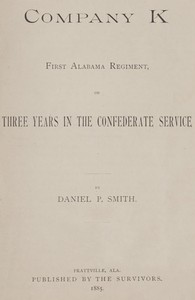
Company K, First Alabama Regiment; or, Three Years in the Confederate Service — Context and Discussion
(0 User reviews)
422
Project Gutenberg
2020
Not confirmed
United States -- History -- Civil War, 1861-1865 -- Regimental histories; United States -- History -- Civil War, 1861-1865 -- Personal narratives, Confederate; Confederate States of America. Army. Alabama Infantry Regiment, 1st. Company K
Readers of public-domain and historical texts
Project Gutenberg digital edition
en
Edition facts
Words
42,070
Reading time
183 min
Text sections
16
Company K, First Alabama Regiment; or, Three Years in the Confederate Service — Context and Discussion can be approached with a clearer sense of reading commitment from its source measurements: 42,070 words, 3 hr 3 min estimated reading time, and 16 detected text sections.
The text analysis averages about 17.0 words per sentence, while the detected sections provide another way to judge how the source is divided.
Project Gutenberg metadata also associates the work with “United States -- History -- Civil War, 1861-1865 -- Regimental histories,” connecting these edition facts with the source record’s subject description.
Source:
Project Gutenberg record #63820
Daniel P. Smith's regimental history of Company K, First Alabama Infantry, offers a firsthand account of the unit's service from Pensacola to Port Hudson, detailing daily life, siege hardships, and the men's resilience through mule meat rations and countermining operations.
Editorial Edition Score
4.7/5
★★★★★
★★★★★
Calculated from edition completeness, EPUB availability, text structure and catalogue metadata. Not a user rating.
How this score is calculated
- Description quality20 pts
- Title & short description10 pts
- Source metadata20 pts
- Text length15 pts
- Chapters / structure15 pts
- EPUB file integrity20 pts
Total of 100 points, scaled to a 2.5-5.0 range. Editions with an empty description or a missing EPUB file are not scored.
Edition quality
Public-domain source text
Read the source text
The source text is kept in the dedicated reader, separate from this catalogue record and its commentary.
Daniel P. Smith's Company K, First Alabama Regiment; or, Three Years in the Confederate Service is a regimental history that moves from the unit's formation in early 1861 to its surrender at Port Hudson in July 1863. The narrative opens with the organization of ten companies from Alabama counties and their assignment to fortifications at Pensacola, where the men were “accustomed to the use of entrenching tools” as they built batteries and drilled as both heavy artillery and infantry. Smith, a survivor of the regiment, compiled this account from the perspective of Company K, grounding the story in specific details of camp life, engineering work, and combat.
From Pensacola to Port Hudson: A Regiment's Trajectory
The book traces the First Alabama's movements from its initial rendezvous at Pensacola through service in the Western Theater. Smith notes that the regiment was mustered into Confederate service after the state legislature's act, and that seven of the original ten companies re-enlisted for the war after their twelve-month terms expired. The narrative includes the unit's participation in the fight on Santa Rosa Island and the bombardments of November 1861 and January 1862, for which they received commendation from General Bragg. The later siege of Port Hudson occupies a substantial portion of the text, with Smith detailing the gradual depletion of the garrison's resources and the constant threat of enemy mining operations.
Siegecraft and Daily Hardship at Port Hudson
Smith's account of the Port Hudson siege is rich with technical and logistical detail. He describes how the Confederates countermined the enemy's tunnels and “rolled ten-inch shells into their ditches” to disrupt sappers. The narrative also records the failure of a brass rifle due to an incorrectly laid embrasure, a mistake that could only be corrected under cover of darkness because of sharpshooter fire. Food shortages forced the garrison to slaughter mules, and Smith reports that when asked if they would eat mule, the men replied, “Yes; give us dog if necessary.” Peas stored in a church were contaminated with broken glass from bombardment, and some soldiers unknowingly ate corned mule disguised as beef. These details ground the siege in the physical realities of hunger and improvisation.
The Collapse of Resistance and the Surrender
By early July 1863, the garrison's situation was dire. Smith notes that ammunition was nearly exhausted, most cannon on the land fortifications were disabled, and only nine or ten river batteries remained serviceable. Disease had reduced effective strength: out of 5,500 men at the start of the siege, some 600 had been killed or wounded, and at least 2,000 were suffering from camp fever or diarrhoea. On July 7, salutes and cheering from the enemy lines announced the fall of Vicksburg, and General Gardner convened a council of war. The narrative stops short of describing the surrender itself in the excerpts, but the accumulating detail of depletion makes the outcome inevitable.
Voice and Structure: A Survivor's Compilation
Smith writes in a straightforward, reportorial style, often using passive constructions and precise numbers. The book is organized chronologically, with each chapter covering a phase of the regiment's service. The authorial voice is that of a participant-historian, not a memoirist; Smith rarely uses the first person, instead presenting collective actions and decisions. The text includes official documents, such as the list of officers and the terms of surrender, but the core of the narrative is the day-to-day experience of the men. This structure gives the work the feel of a unit history compiled from shared memory and official records, rather than a personal diary.
Readers approaching Smith's work should expect a factual, detail-oriented narrative that prioritizes the collective experience of Company K over individual heroics. The book is best read as a primary source for the logistics and morale of a Confederate regiment under siege, rather than as a dramatic personal story. Smith's attention to the mechanics of fortification, the management of scarce supplies, and the slow erosion of combat effectiveness offers a ground-level view of the war that complements broader histories of the Western Theater.
There’s something humbling about reading how those men endured Port Hudson on mule meat, their stubbornness carrying them through. It makes me want to sit quietly with the old voices who learned resilience differently, the practical wisdom in Little Visits with Great Americans, Vol. 1 (of 2) Or Success, Ideals and How to Attain Them — Text and Context. Different wars, same quiet grit, I suppose.
There are no reviews for this eBook.
There are no comments for this eBook.
Reader reflection
How did this book work for you?
Your answers remain private and are stored only in this browser.
Your progress
0
/
10
2
What was your overall reaction to the book?
3
Would you pass this book on to a friend?
4
What was the reading difficulty like?
5
How personally connected did you feel to the book?
6
Could you apply anything you learned?
7
Would a second reading be valuable?
8
How distinctive were its ideas or approach?
9
Which lesson or insight stayed with you?
10