1

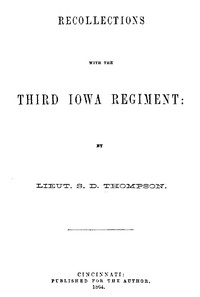
Recollections with the Third Iowa Regiment — A Closer Reading
(0 User reviews)
632
Project Gutenberg
2014
Not confirmed
United States -- History -- Civil War, 1861-1865 -- Regimental histories; United States. Army. Iowa Infantry Regiment, 3rd (1861-1864)
Readers of public-domain and historical texts
Project Gutenberg digital edition
en
Edition facts
Words
109,404
Reading time
476 min
Text sections
9
Recollections with the Third Iowa Regiment — A Closer Reading can be approached with a clearer sense of reading commitment from its source measurements: 109,404 words, 7 hr 56 min estimated reading time, and 9 detected text sections.
The text analysis averages about 20.0 words per sentence, while the detected sections provide another way to judge how the source is divided.
Project Gutenberg metadata also associates the work with “United States -- History -- Civil War, 1861-1865 -- Regimental histories,” connecting these edition facts with the source record’s subject description.
Source:
Project Gutenberg record #47795
A lieutenant's diary-based account of service with the Third Iowa Regiment from 1861 to 1864, focusing on camp life, the Shiloh battle, and the regiment's operations, written for his comrades and published in 1864.
Editorial Edition Score
4.8/5
★★★★★
★★★★★
Calculated from edition completeness, EPUB availability, text structure and catalogue metadata. Not a user rating.
How this score is calculated
- Description quality20 pts
- Title & short description10 pts
- Source metadata20 pts
- Text length15 pts
- Chapters / structure15 pts
- EPUB file integrity20 pts
Total of 100 points, scaled to a 2.5-5.0 range. Editions with an empty description or a missing EPUB file are not scored.
Edition quality
Public-domain source text
Read the source text
The source text is kept in the dedicated reader, separate from this catalogue record and its commentary.
Seymour D. Thompson, a lieutenant in the Third Iowa Regiment, compiled this narrative from a diary he kept during two years of service. The preface states the book was written at the solicitation of comrades and is dedicated to them, with the author noting it was composed "in the tent of the soldier, not in the library of the historian." This origin shapes the text's perspective: it is a participant's record, not a formal history, and Thompson acknowledges possible inaccuracies in facts that later became history.
The excerpts reveal a voice that blends personal observation with tactical critique. For instance, Thompson describes the camp at Pittsburg Landing before Shiloh, noting the "city of white tents in the solemn forest" and the "air full of martial sounds." He also offers pointed commentary on the army's dangerous position, with an impassable river to the rear and inadequate picketing, calling the delay in advancing "nearly fatal."
A Diary Shaped by Comradeship
Thompson explicitly frames his work as a record for fellow soldiers, not a general audience. The preface states he compiled the pages "from a diary which I kept during most of the two years I served with them." This origin explains the text's direct, unpolished quality: it was written amid the scenes it describes, not retrospectively from a library. The author's dedication—"to them I dedicate it"—indicates the intended readership was the regiment itself, which likely influenced what details were included or omitted. Readers should expect a narrative that assumes familiarity with the unit's movements and personnel, occasionally leaving context implicit.
The Perilous Camp at Pittsburg Landing
Thompson's description of the camp before Shiloh is rich with sensory detail and strategic anxiety. He notes the "confusion of hills, ravines, and cross-roads" and the "city of white tents in the solemn forest." The atmosphere is filled with "martial sounds": artillery drills, soldiers discharging pieces, bugles, bands, and even a steam calliope on a transport. Yet beneath this spectacle, Thompson identifies a precarious situation: the army was camped with an impassable river to the rear, an impenetrable forest on the flanks, and inadequate picketing. He writes that "the soldiers themselves were not so stupid as not to discern the peril," and he recounts a captain and a soldier discussing the danger the evening before the battle. This section shows Thompson blending vivid scene-setting with tactical critique, a pattern that likely continues throughout the book.
Critique of Command Decisions
Thompson does not shy from criticizing higher command. He states that the delay in advancing after arriving at Pittsburg Landing gave the enemy time to concentrate at Corinth, calling it "our blunder in failing to deal the enemy a decisive blow." He also notes that the commanding general's headquarters were at Savannah, eight miles away, and that "not even the ordinary precautions were taken" against attack. These observations are presented as the author's own, based on what he saw and heard. The preface acknowledges that some officers had passed into civil life and could be criticized, while those still in service are treated with deference. This suggests the narrative may balance candid assessment with the constraints of a soldier's duty.
Voice and Structure: From Diary to Published Account
The excerpts show a text that moves between immediate diary-like entries and more reflective passages. Thompson's prose is direct and often declarative, as when he writes "Ah! how nearly fatal was the delay!" He uses the first-person plural "we" extensively, reinforcing the collective experience of the regiment. The structure appears chronological, beginning with the "uprising" in Iowa and progressing through the regiment's service. The preface mentions that the book includes "sketches of the operations in which they were engaged, and of which our Regiment formed a part." Readers should expect a mix of personal anecdote, unit history, and occasional strategic commentary, all filtered through Thompson's perspective as a lieutenant on the ground.
Thompson's account is best approached as a primary source from a junior officer who wrote for his comrades, not for posterity. The diary origins lend immediacy to descriptions of camp life and battle, while the author's willingness to critique command decisions offers a ground-level view of the war. Readers should note that the text is incomplete in the excerpts provided; the full work likely covers the regiment's entire service from 1861 to 1864. The narrative's value lies in its specific, unvarnished observations of a soldier's experience in the Western Theater.
Reading this lieutenant’s diary, I kept thinking about how the quietest moments—tent flaps at dawn, letters half-finished—often linger longest. It reminded me of the strange intimacy in Life and Remarkable Adventures of Israel R. Potter — A Closer Reading, where survival is measured in ordinary gestures. Both feel less like history than like someone speaking low, years later, hoping you’ll understand.
There are no reviews for this eBook.
There are no comments for this eBook.
Reader reflection
How did this book work for you?
Your answers remain private and are stored only in this browser.
Your progress
0
/
10
2
Was reading this book enjoyable?
3
Would you encourage someone else to read it?
4
How much effort did this book require?
5
Could you follow the author’s main argument?
6
Would you read this book again?
7
What did you appreciate most?
8
Did it raise ideas you would like to talk about?
9
What did this book teach you most?
10