1

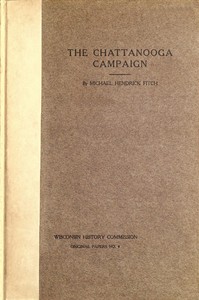
The Chattanooga Campaign: With especial reference to Wisconsin's participation therein — Background and Themes
(0 User reviews)
616
Project Gutenberg
2022
Not confirmed
United States -- History -- Civil War, 1861-1865 -- Campaigns; Chattanooga, Battle of, Chattanooga, Tenn., 1863; Chickamauga, Battle of, Ga., 1863
Readers of public-domain and historical texts
Project Gutenberg digital edition
en
Edition facts
Words
50,811
Reading time
221 min
Text sections
20
The catalog record for The Chattanooga Campaign: With especial reference to Wisconsin's participation therein — Background and Themes provides practical reading context through 50,811 words, 3 hr 41 min estimated reading time, and 20 detected text sections.
The text analysis averages about 20.5 words per sentence, while the detected sections provide another way to judge how the source is divided.
Project Gutenberg metadata also associates the work with “United States -- History -- Civil War, 1861-1865 -- Campaigns,” connecting these edition facts with the source record’s subject description.
Source:
Project Gutenberg record #68855
A 1911 regimental history by Lieutenant-Colonel Michael Hendrick Fitch, focusing on Wisconsin troops in the Chattanooga campaign. The narrative uses statistical tables and comparative loss figures to argue for the effectiveness of Union divisions, while noting the author's role as a participant in the Twenty-first Wisconsin Infantry.
Editorial Edition Score
4.9/5
★★★★★
★★★★★
Calculated from edition completeness, EPUB availability, text structure and catalogue metadata. Not a user rating.
How this score is calculated
- Description quality20 pts
- Title & short description10 pts
- Source metadata20 pts
- Text length15 pts
- Chapters / structure15 pts
- EPUB file integrity20 pts
Total of 100 points, scaled to a 2.5-5.0 range. Editions with an empty description or a missing EPUB file are not scored.
Edition quality
Public-domain source text
Read the source text
The source text is kept in the dedicated reader, separate from this catalogue record and its commentary.
Lieutenant-Colonel Michael Hendrick Fitch, a veteran of the Twenty-first Wisconsin Infantry, wrote this campaign history as part of the Wisconsin History Commission's Original Papers series. Rather than a sweeping overview, Fitch drills into the tactical details of Chickamauga and Chattanooga, often pausing to tabulate casualties by brigade. His prose is that of a staff officer turned analyst: he compares Union and Confederate losses, weighs the effect of breastworks, and calculates the relative fighting power of divisions. The book's subtitle—'With especial reference to Wisconsin's participation therein'—signals a dual purpose: to record state contributions and to argue that Wisconsin regiments performed with distinction under fire.
Numbers as Testimony
Fitch relies heavily on numerical evidence. In the excerpt, he constructs two comparative tables of killed and wounded for the Chickamauga fighting around Kelly Field. He tallies 14 Union brigades against 19 Confederate, then calculates that the five Union divisions in the first table inflicted 8,625 casualties while suffering 5,083. He is careful to note that Brannan's division, which fought without breastworks on September 20, lost about 800 more men than any protected Union division—'a practical illustration of the value of the precautions.' The author does not simply report numbers; he interprets them, drawing conclusions about unit effectiveness and the cost of entrenchment.
The Author's Voice and Perspective
Fitch writes as a participant-scholar. He refers to 'the five Union divisions' and 'the deadly fighting' with the authority of someone who was there, yet he maintains a detached, analytical tone. His language is precise: he notes that Breckenridge 'was not in the fight of the 19th' and that Van Derveer's brigade 'made one charge' along the Kelly field. The authorial 'we' appears sparingly, as when he says 'We will make a similar comparison.' This blend of personal knowledge and statistical rigor gives the narrative a distinctive voice—neither dry report nor memoir, but a hybrid that trusts tables to speak for the valor of troops.
Structure and Focus on Wisconsin
The book's organization follows the campaign chronologically, but its focus narrows repeatedly to Wisconsin units. Chapter headings such as 'Wisconsin troops at Chickamauga' and 'Wisconsin troops in the Battle of Missionary Ridge' make this explicit. The excerpts show Fitch comparing brigade-level losses across divisions, yet the overall framework is designed to highlight the state's contribution. He does not claim that Wisconsin regiments alone decided the battle; instead, he embeds their actions within larger tactical movements, using the official returns to show that they held their ground against superior numbers. The maps—including one titled 'The fatal order to Wood, at Chickamauga'—further emphasize critical moments where Wisconsin soldiers were engaged.
Evidence from Official Returns
Fitch grounds his argument in the 'official returns' of both armies. He cites Colonel W. F. Fox's Regimental Losses in the Civil War for Confederate totals, and he cross-references Longstreet's report to estimate losses on the Union right. His method is transparent: he subtracts Stewart's loss from Longstreet's figure to derive the casualties inflicted by seven Union divisions. This forensic approach—deducing one number from another, then comparing ratios—is unusual in campaign histories of the period. Fitch is not content to narrate; he wants to prove that Union troops, including Wisconsin's own, exacted a disproportionate toll on the enemy.
Readers should approach this volume as a veteran's analytical memoir rather than a neutral history. Fitch's tables and comparisons are his primary evidence, and his conclusions are shaped by a desire to honor Wisconsin's soldiers. The book rewards those who read the numbers alongside the narrative, watching how the author turns casualty lists into arguments about courage and competence.
Rain drummed on the windowsill that gray afternoon as I traced Fitch’s careful tables of Wisconsin’s losses at Chattanooga. His dry arithmetic somehow made the mud and blood feel more real, not less. Afterwards, restless, I picked up A Boy’s Experience in the Civil War, 1860-1865 — A Reader’s Guide. It was a younger, softer witness to the same storm—a different way of counting what the rain washed away.
There are no reviews for this eBook.
There are no comments for this eBook.
Reader reflection
What did you think of this book?
Answer a few questions and save a private reflection on this device.
Your progress
0
/
10
2
Did this book hold your interest?
3
Would you encourage someone else to read it?
4
How easy was the book to follow?
5
Did any part of the book feel personally relevant?
6
Could you apply anything you learned?
7
How would you describe its reading pace?
8
Which aspect of the book did you value most?
9
What did this book teach you most?
10