1

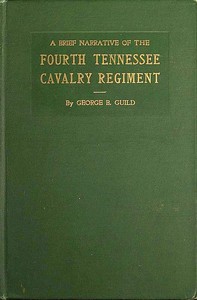
A brief narrative of the Fourth Tennessee Cavalry Regiment, Wheeler's Corps, Army of Tennessee — Context and Discussion
(0 User reviews)
107
Project Gutenberg
2015
Not confirmed
Wheeler, Joseph, 1836-1906; Confederate States of America. Army. Tennessee Cavalry Regiment, 4th; United States -- History -- Civil War, 1861-1865 -- Regimental histories -- Tennessee Calvary -- 4th
Readers of public-domain and historical texts
Project Gutenberg digital edition
en
Edition facts
Words
69,885
Reading time
304 min
Text sections
9
For A brief narrative of the Fourth Tennessee Cavalry Regiment, Wheeler's Corps, Army of Tennessee — Context and Discussion, the stored edition analysis reports 69,885 words, 5 hr 4 min estimated reading time, and 9 detected text sections.
The text analysis averages about 19.2 words per sentence, while the detected sections provide another way to judge how the source is divided.
Project Gutenberg metadata also associates the work with “Wheeler, Joseph, 1836-1906,” connecting these edition facts with the source record’s subject description.
Source:
Project Gutenberg record #49238
George B. Guild's regimental history of the 4th Tennessee Cavalry, written in 1913, blends official reports, personal recollection, and a dedication to fallen comrades. The narrative voice shifts from terse battle accounts to reflective passages, revealing the author's dual role as adjutant and memorialist.
Editorial Edition Score
4.7/5
★★★★★
★★★★★
Calculated from edition completeness, EPUB availability, text structure and catalogue metadata. Not a user rating.
How this score is calculated
- Description quality20 pts
- Title & short description10 pts
- Source metadata20 pts
- Text length15 pts
- Chapters / structure15 pts
- EPUB file integrity20 pts
Total of 100 points, scaled to a 2.5-5.0 range. Editions with an empty description or a missing EPUB file are not scored.
Edition quality
Public-domain source text
Read the source text
The source text is kept in the dedicated reader, separate from this catalogue record and its commentary.
George B. Guild, adjutant of the Fourth Tennessee Cavalry Regiment, wrote this history in 1913, drawing on official reports and his own service. The dedication immediately establishes a commemorative tone: it addresses comrades who died, their graves marked by rough boards that have rotted, mounds leveled by plowshares. This elegiac opening contrasts with the brisk, factual style of the chapters that follow, where Guild often reproduces orders, correspondence, and after-action reports verbatim.
The narrative voice is not uniform. In the surrender negotiations chapter, Guild transcribes the Johnston-Sherman correspondence in full, letting official documents carry the story. Elsewhere, he shifts to first-person recollection, as when he describes delivering a letter to Lieutenant General Hampton. This alternation between archival and personal modes gives the book an uneven but revealing texture.
A Dedication That Sets the Register
The dedication page is the most stylistically distinctive part of the book. Guild addresses those who “went with us but came not back again,” then describes their graves in a lyrical, almost pastoral register: “the wild flower sheds its sweetest perfume to the morning air, and the song bird warbles its lay to the setting sun.” This language is markedly different from the plain, reportorial prose of the regimental narrative. The contrast suggests that Guild reserved his most literary voice for the fallen, while the history itself is meant to be a factual record. The dedication also establishes a tension between the desire to memorialize and the need to document—a tension that runs through the entire work.
Official Documents as Narrative Engine
Guild frequently inserts full transcriptions of military correspondence and agreements. In Chapter XI, he reproduces the seven-article memorandum of surrender between Johnston and Sherman, including the stipulation that Confederate armies “be disbanded and conducted to their several State Capitols.” These documents are not summarized but quoted at length, slowing the narrative pace and shifting authority from the author to the historical actors. The effect is that the book sometimes reads like a sourcebook rather than a continuous story. Guild’s own voice recedes, and the documents speak for themselves. This technique is especially noticeable in the surrender chapter, where the armistice negotiations are presented almost entirely through letters and memoranda.
Shifts in Pace and Perspective
The narrative pace varies sharply between chapters. Early sections, such as the organization and early movements, move quickly through a series of place names and engagements: Franklin, Murfreesboro, Shelbyville, Fort Donelson. Later chapters slow down for extended quotations and detailed accounts of single events, like the surrender negotiations. The perspective also shifts: sometimes Guild writes as a participant (“I was sent by me to Lieutenant General Hampton”), sometimes as a compiler of records. These shifts are not signaled by the author; they occur without transition. Readers must adjust to the changing texture, which ranges from telegraphic battle reports to reflective passages about the fate of the regiment’s dead.
Guild’s history is best approached as a hybrid document: part memoir, part archive. Readers interested in the texture of Confederate cavalry service will find value in the official reports and correspondence he preserves. Those looking for a unified narrative may need to supply connections that Guild leaves implicit. The book rewards attention to its shifts in register—from the lyrical dedication to the dry memorandum—as evidence of how one veteran chose to remember and record.
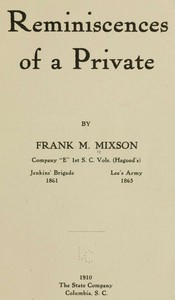
Guild’s account of the Fourth Tennessee carries that heavy quiet of a man writing names he once knew aloud. There is a similar ache in Reminiscences of a Private by Frank M. Mixson, Company "E" 1st S. C. Vols. (Hagood's) — Reading Notes, though from the other side of the fence. Both men simply remembered, and we are lucky to overhear.
There are no reviews for this eBook.
There are no comments for this eBook.
Reader reflection
How will you remember this book?
Save your reaction, strongest insight, and memorable passage.
Your progress
0
/
10
2
Did this book hold your interest?
3
Is this a title you would suggest to others?
4
How easy was the book to follow?
5
How useful did the reading feel?
6
How clearly were the main ideas presented?
7
How would you describe its reading pace?
8
Did any part of the book feel personally relevant?
9
What changed or sharpened your thinking?
10