1

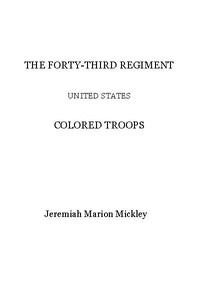
The Forty-third regiment United States Colored Troops — Reading Companion
(0 User reviews)
957
Project Gutenberg
2014
Not confirmed
United States -- History -- Civil War, 1861-1865 -- Regimental histories; United States. Army. Infantry. Colored Infantry Regiment, 43rd (1864-1865)
Readers of public-domain and historical texts
Project Gutenberg digital edition
en
Edition facts
Words
20,547
Reading time
90 min
Text sections
2
The catalog record for The Forty-third regiment United States Colored Troops — Reading Companion provides practical reading context through 20,547 words, 1 hr 30 min estimated reading time, and 2 detected text sections.
The text analysis averages about 16.6 words per sentence, while the detected sections provide another way to judge how the source is divided.
Project Gutenberg metadata also associates the work with “United States -- History -- Civil War, 1861-1865 -- Regimental histories,” connecting these edition facts with the source record’s subject description.
Source:
Project Gutenberg record #46181
Jeremiah Marion Mickley's regimental history profiles officers of the 43rd USCT through service records, battle lists, and pre-war backgrounds, using a biographical structure that emphasizes discipline and bravery as evidence for the effectiveness of Black troops.
Editorial Edition Score
4.5/5
★★★★★
★★★★★
Calculated from edition completeness, EPUB availability, text structure and catalogue metadata. Not a user rating.
How this score is calculated
- Description quality20 pts
- Title & short description10 pts
- Source metadata20 pts
- Text length15 pts
- Chapters / structure15 pts
- EPUB file integrity20 pts
Total of 100 points, scaled to a 2.5-5.0 range. Editions with an empty description or a missing EPUB file are not scored.
Edition quality
Public-domain source text
Read the source text
The source text is kept in the dedicated reader, separate from this catalogue record and its commentary.
Jeremiah Marion Mickley, late chaplain of the 43rd Regiment United States Colored Troops, opens his 1866 volume with a pointed claim: the pages are meant to furnish “an unanswerable argument” for the value of Black soldiers in the Union army. The book is not a narrative campaign history but a series of officer biographies, each tracing a man from civilian life through his wartime service. Mickley’s method is cumulative: by stacking individual records—enlistment dates, promotions, battle participations—he builds a case for the regiment’s “extraordinary good discipline, efficiency and bravery.” The prose is spare, factual, and repetitive, a deliberate rhetorical choice that treats each officer’s file as a piece of evidence.
Biography as Argument
Mickley structures his book as a roster of commissioned officers, each entry following a fixed template: birthplace, family military history, pre-war occupation, volunteer enlistment, promotions, and a list of engagements. Captain Horace F. Burr, for instance, is introduced as “a native of Charlestown, Mass.” who “had passed two years at sea in the ship ‘Panther.’” The pattern repeats for nearly every officer, creating a rhythm of data rather than narrative. Mickley’s introduction frames this repetition as purposeful: the biographies are “designed for their own use” but also intended to prove that Black troops are “very susceptible of intellectual and moral culture.” By foregrounding the officers’ civilian competence—sailors, farmers, clerks—he implies that the regiment’s discipline reflects the character of its leaders.
The Weight of Battle Lists
Each officer’s entry culminates in a litany of battles, often identical across multiple men: Wilderness, Spotsylvania, Cold Harbor, Petersburg, the Mine, Weldon Railroad, Poplar Grove Church, Hatchie’s Run, and the capture of Richmond. For Lieutenant A. A. Shedd, the list runs to fourteen named actions, each dated with precision. The repetition of these same engagements across different biographies underscores the regiment’s continuous presence in the Virginia theater from May 1864 to April 1865. Mickley does not describe the fighting; he merely records that the officer “was present with his Company in all its duties and engagements.” The effect is cumulative—the reader sees the 43rd USCT as a unit that endured a full year of hard campaigning, from the Wilderness to the fall of Richmond.
Pre-War Lives and Nautical Threads
A striking pattern in the biographies is the number of officers with seafaring backgrounds. Colonel S. B. Yeoman “started as a sailor before the mast at fifteen years of age” and survived a shipwreck on New Zealand; Captain Burr “passed two years at sea in the ship ‘Panther.’” Mickley records these details without commentary, but they accumulate into a quiet theme: the regiment’s officers were not professional soldiers but men who had already demonstrated resilience in dangerous occupations. The nautical experience also provides a contrast to the land-based warfare of the Wilderness and Petersburg trenches. Mickley’s decision to include such pre-war specifics—rather than only military service—suggests he valued the officers’ civilian competence as part of their qualification to lead Black troops.
The Chaplain’s Voice and Omissions
Mickley writes in the third person throughout, referring to himself only in the introduction as “late Chaplain of the Regiment.” His authorial presence is otherwise invisible; he never uses “I” or offers personal anecdotes. The tone is consistently administrative, even when recording acts of gallantry. Lieutenant Shedd, for example, “is highly spoken of for his great gallantry at the battle of Hatchie’s Run” where “his horse was shot from under him”—but Mickley does not elaborate. The restraint is notable given the book’s stated purpose as an argument for Black troops. Mickley lets the records speak, trusting that the bare facts of service and promotion will carry his case. What is absent—descriptions of the men themselves, their voices, their experiences—marks the limits of his project: this is a history of the regiment’s officers, not of the enlisted soldiers.
Structure as Evidence
Mickley’s organizational choice—a series of individual files rather than a continuous narrative—reflects a documentary impulse. Each officer’s entry stands alone, with its own heading and list of battles, making the book easy to consult as a reference. The repetition of battle names across entries reinforces the regiment’s shared experience. The book’s brevity (about 20,000 words) and its 1866 publication date suggest it was compiled quickly after the war, likely from official records and personal correspondence. Mickley’s preface notes that the pages were “elicited by request of numerous friends of the officers,” indicating a private, commemorative audience. The structure thus serves dual purposes: it memorializes individuals and, through accumulation, makes a public argument about the effectiveness of the USCT.
Readers approaching Mickley’s text should expect a reference work rather than a memoir. The book’s value lies in its precise documentation of officer careers and battle participation, offering a granular view of one USCT regiment’s service. For those interested in the administrative side of Civil War military history—how units were staffed, how promotions were recorded, how service was summarized—this volume provides primary-source material. Mickley’s deliberate restraint, his refusal to embellish, makes the facts themselves the argument.
That rainy afternoon, turning pages of the Forty-third’s records, I kept noticing how discipline and quiet courage shaped each officer’s entry. It felt less like history than weather—slow, inevitable. Later, coffee-cool and restless, I reached for The 21st Missouri Regiment Infantry Veteran Volunteers: Historical Memoranda — Text and Context. Same patched coats, same unspoken grit. One book simply opened the next, like a door left ajar.
There are no reviews for this eBook.
There are no comments for this eBook.
Reader reflection
Take a moment to reflect on this book
Create a short personal record of your experience with this book.
Your progress
0
/
10
2
What was your overall reaction to the book?
3
How likely are you to recommend this book?
4
Did the language feel accessible?
5
Did the book give you something worth debating?
6
Did any part of the book stay with you emotionally?
7
How understandable was the text?
8
Which part made the strongest impression?
9
Which lesson or insight stayed with you?
10