1

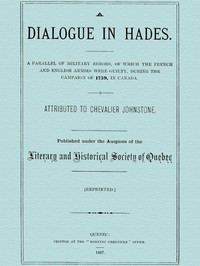
A Dialogue in Hades A Parallel of Military Errors, of Which the French and English Armies Were Guilty, During the Campaign of 1759, in Canada — Themes and Context
(0 User reviews)
2298
Project Gutenberg
2013
Not confirmed
United States -- History -- French and Indian War, 1754-1763; Québec Campaign, Québec, 1759
Readers of public-domain and historical texts
Project Gutenberg digital edition
en
Edition facts
Words
23,897
Reading time
104 min
Text sections
3
This digital edition of A Dialogue in Hades A Parallel of Military Errors, of Which the French and English Armies Were Guilty, During the Campaign of 1759, in Canada — Themes and Context is described by source-level measurements including 23,897 words, 1 hr 44 min estimated reading time, and 3 detected text sections.
The text analysis averages about 29.5 words per sentence, while the detected sections provide another way to judge how the source is divided.
Project Gutenberg metadata also associates the work with “United States -- History -- French and Indian War, 1754-1763,” connecting these edition facts with the source record’s subject description.
Source:
Project Gutenberg record #44381
A posthumous dialogue between Montcalm and Wolfe debating the 1759 Quebec campaign, with Johnstone using the form to assign blame and defend French conduct through specific tactical arguments.
Editorial Edition Score
4.5/5
★★★★★
★★★★★
Calculated from edition completeness, EPUB availability, text structure and catalogue metadata. Not a user rating.
How this score is calculated
- Description quality20 pts
- Title & short description10 pts
- Source metadata20 pts
- Text length15 pts
- Chapters / structure15 pts
- EPUB file integrity20 pts
Total of 100 points, scaled to a 2.5-5.0 range. Editions with an empty description or a missing EPUB file are not scored.
Edition quality
Public-domain source text
Read the source text
The source text is kept in the dedicated reader, separate from this catalogue record and its commentary.
The Chevalier Johnstone, a Scottish Jacobite who served as aide-de-camp to both Levis and Montcalm, frames his critique of the 1759 campaign as a dialogue between the dead generals Montcalm and Wolfe in Hades. This unusual structure allows him to present a parallel of military errors while defending French decisions—especially Montcalm's—against accusations of incompetence. The work is less a neutral history than a partisan brief, written around 1765, five years after Johnstone returned to France.
A Dialogue of the Dead as Military Apologia
Johnstone adopts the classical dialogue-of-the-dead form, popularized by Lucian and later by Fontenelle, to stage a post-mortem debate. Montcalm and Wolfe speak from Hades, each justifying his own actions and blaming the other. This device lets Johnstone air grievances without writing a straightforward memoir. Montcalm’s speeches are notably defensive: he complains of “scandalous, atrocious lies and calumnies” spread by “vile, mercenary souls” who put greed before honor. The emotional register—Montcalm calls his accusers “vermin”—reveals a personal vendetta beneath the tactical analysis.
The Cove and the Deserter: A Chain of Blame
A key argument in the dialogue concerns Wolfe’s landing at Anse au Foulon (Wolfe’s Cove). Johnstone has Montcalm claim that deserters from the French army revealed the weak point, enabling the British to ascend the cliffs. He writes that “the deserters caused you to make a last attempt” and that a vigilant officer at that post might have prevented the desertions. This shifts responsibility from Montcalm’s dispositions to a subordinate’s failure. The passage ties a single tactical oversight—a neglected guard post—to the loss of Canada, illustrating Johnstone’s method of tracing large outcomes to small, preventable errors.
Historical Context and the Author’s Perspective
The introductory note explains that Johnstone was a Scottish Jacobite who fled after Culloden and obtained a commission in the French army. He served in Canada from 1748 to 1760, acting as Montcalm’s aide-de-camp during the 1759 campaign due to his knowledge of the Beauport defenses. The note also states that Johnstone “differs in toto” from other French officers regarding the Canadian militia’s conduct, crediting them with saving part of the army on September 13. This context is essential: the dialogue is not an impartial account but the argument of an insider with a stake in Montcalm’s reputation.
Style and Structure: Prolixity and Quotation
The editor’s note describes Johnstone’s style as “prolix, sententious, abounding in quotations from old writers.” The excerpts bear this out: Montcalm cites Ferdinand of Aragon’s campaign against the Moors to justify attacking at difficult points. The prose is dense, with long sentences and classical allusions. Johnstone’s English is noted as imperfect—he had “forgotten or had never thoroughly known the language”—which gives the text an idiosyncratic, sometimes awkward rhythm. Readers should expect a challenging but distinctive voice, not a polished narrative.
Because the excerpts are incomplete, the full scope of Johnstone’s argument remains unclear. The dialogue may cover other battles or continue the blame-shifting. Readers should treat Montcalm’s speeches as Johnstone’s advocacy, not verbatim record. The work is best approached as a primary source for the French perspective on 1759, filtered through a loyal aide’s memory and grievance.
Years at this desk have taught me how two books may keep a quiet company. This old dialogue of Montcalm and Wolfe—their restless ghosts still wrangling over a bay’s wrong turn—shares with Stand By! Naval Sketches and Stories — Text and Context a certain salt-stained patience for human error, whether on a field or a deck, both whispering that valor rarely steers clear of regret.
There are no reviews for this eBook.
There are no comments for this eBook.
Reader reflection
Before you leave, reflect on the book
Use these questions to collect your thoughts before moving on.
Your progress
0
/
10
2
What was your overall reaction to the book?
3
Would you encourage someone else to read it?
4
How much effort did this book require?
5
Could you apply anything you learned?
6
Did the book deliver what you hoped for?
7
Is this a title worth rereading?
8
Did this book create an emotional response?
9
What changed or sharpened your thinking?
10