1

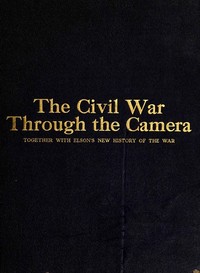
The Civil War Through the Camera — Story, Setting & Ideas
(0 User reviews)
1957
Project Gutenberg
2013
Not confirmed
United States -- History -- Civil War, 1861-1865; United States -- History -- Civil War, 1861-1865 -- Pictorial works
Readers of public-domain and historical texts
Project Gutenberg digital edition
en
Edition facts
Words
150,026
Reading time
653 min
Text sections
17
Before opening The Civil War Through the Camera — Story, Setting & Ideas, the edition data offers a quick orientation: 150,026 words, 10 hr 53 min estimated reading time, and 17 detected text sections.
The text analysis averages about 20.5 words per sentence, while the detected sections provide another way to judge how the source is divided.
Project Gutenberg metadata also associates the work with “United States -- History -- Civil War, 1861-1865,” connecting these edition facts with the source record’s subject description.
Source:
Project Gutenberg record #42655
A 1912 illustrated history pairing Mathew Brady's Civil War photographs with Henry W. Elson's narrative, tracing major battles from Bull Run to Appomattox with a focus on military strategy and national significance.
Editorial Edition Score
4.9/5
★★★★★
★★★★★
Calculated from edition completeness, EPUB availability, text structure and catalogue metadata. Not a user rating.
How this score is calculated
- Description quality20 pts
- Title & short description10 pts
- Source metadata20 pts
- Text length15 pts
- Chapters / structure15 pts
- EPUB file integrity20 pts
Total of 100 points, scaled to a 2.5-5.0 range. Editions with an empty description or a missing EPUB file are not scored.
Edition quality
Public-domain source text
Read the source text
The source text is kept in the dedicated reader, separate from this catalogue record and its commentary.
This volume pairs hundreds of photographs taken by Mathew B. Brady and his operators during the Civil War with a narrative history by Henry W. Elson, a professor at Ohio University. First published in 1912, the book organizes the war into twenty-six chapters, each covering a major campaign or battle. The text is supplemented by sixteen color reproductions of war paintings. The opening chapter on Fort Sumter sets a dramatic tone, describing the first gun fired from Fort Johnson as a signal that launched “the greatest conflict the world has ever known.”
Photography as Historical Record
Brady’s photographs are the book’s central feature, but Elson’s text does not treat them as mere illustrations. The narrative often describes scenes that the camera could not capture—such as the tension inside Fort Sumter before the bombardment—while the photographs freeze moments after the fact: posed groups of soldiers, empty battlefields, and destroyed fortifications. This creates a tension between the immediacy of the image and the retrospective analysis of the historian. The book’s title, The Civil War Through the Camera, suggests that the photographs provide direct access to the past, yet Elson’s prose frequently reminds readers that the war’s meaning was constructed afterward, through words and memory.
The Gettysburg Chapter as a Turning Point
The chapter on Gettysburg is the longest in the excerpts and is framed as “the high-water mark of the Civil War.” Elson emphasizes the battle’s symbolic geography: fought in Pennsylvania, the birthplace of the Declaration of Independence and the Constitution. He describes the town as a “quiet hamlet” of fifteen hundred inhabitants, its hills “gentle swells of ground” covered with timber. The narrative contrasts the pastoral setting with the scale of the conflict, noting that Lee’s army was “flushed with victory” while the Army of the Potomac had “met with continual discouragement.” The chapter includes the full text of Lincoln’s Gettysburg Address, positioning the battle as both a military climax and a moment of national redefinition.
Contrasts in Leadership and Fortune
Elson repeatedly contrasts the fortunes of Union and Confederate commanders. In the Fort Sumter chapter, Major Robert Anderson is portrayed as a figure who “handled the situation at the breaking point,” preserving honor without provoking unnecessary bloodshed. Later, Lee is shown as a commander who must adapt when his plans go awry—Stuart’s failure to detain Hooker forces Lee to change course. The narrative structure highlights how individual decisions, such as Anderson’s refusal to surrender or Lee’s rapid reassessment, shape the war’s trajectory. These contrasts are not merely tactical; they reflect Elson’s broader argument that the war tested the character of leaders as much as the strength of armies.
Readers should approach this book as a hybrid work: part photographic archive, part historical argument. The images reward close attention to details of uniform, terrain, and equipment, while the text offers a coherent narrative shaped by early twentieth-century perspectives. Comparing the photographs with Elson’s descriptions reveals what the camera could show and what it could not—a useful exercise for understanding how history is made from fragments.
Sometimes those old Brady photographs feel almost too still, too framed. But reading that 1912 history, I kept wanting the mud, the quiet fear between the lines. There's a book that lingers closer to that—one soldier's voice, unpolished, raw, like a letter found in an attic. It made me see the bigger story anew. Personal Reminiscences of the War of 1861-5 In Camp—en Bivouac—on the March—on Picket—on the Skirmish Line—on the Battlefield—and in Prison — A Reader’s Guide holds that same humbling weight.
There are no reviews for this eBook.
There are no comments for this eBook.
Reader reflection
What was your reading experience?
Capture what you thought, learned, and would like to remember.
Your progress
0
/
10
2
Did this book hold your interest?
3
Would you encourage someone else to read it?
4
How much effort did this book require?
5
What did you think about the pace?
6
Did this book create an emotional response?
7
Did the book give you something worth debating?
8
Which element worked best for you?
9
What changed or sharpened your thinking?
10