1

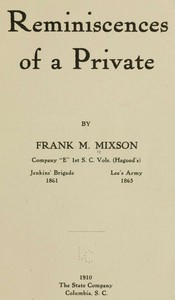
Reminiscences of a Private by Frank M. Mixson, Company "E" 1st S. C. Vols. (Hagood's) — Reading Notes
(0 User reviews)
632
Project Gutenberg
2012
Not confirmed
United States -- History -- Civil War, 1861-1865 -- Personal narratives, Confederate; Confederate States of America. Army. South Carolina Infantry Regiment, 1st
Readers of public-domain and historical texts
Project Gutenberg digital edition
en
Edition facts
Words
36,216
Reading time
158 min
Text sections
3
Reminiscences of a Private by Frank M. Mixson, Company "E" 1st S. C. Vols. (Hagood's) — Reading Notes can be approached with a clearer sense of reading commitment from its source measurements: 36,216 words, 2 hr 38 min estimated reading time, and 3 detected text sections.
The text analysis averages about 18.9 words per sentence, while the detected sections provide another way to judge how the source is divided.
Project Gutenberg metadata also associates the work with “United States -- History -- Civil War, 1861-1865 -- Personal narratives, Confederate,” connecting these edition facts with the source record’s subject description.
Source:
Project Gutenberg record #41616
Frank M. Mixson's firsthand account of his service in Company E, 1st South Carolina Volunteers, from 1861 to 1865, focusing on the daily life, combat, and camaraderie of a Confederate private, based on his wartime experiences and later recollections.
Editorial Edition Score
4.5/5
★★★★★
★★★★★
Calculated from edition completeness, EPUB availability, text structure and catalogue metadata. Not a user rating.
How this score is calculated
- Description quality20 pts
- Title & short description10 pts
- Source metadata20 pts
- Text length15 pts
- Chapters / structure15 pts
- EPUB file integrity20 pts
Total of 100 points, scaled to a 2.5-5.0 range. Editions with an empty description or a missing EPUB file are not scored.
Edition quality
Public-domain source text
Read the source text
The source text is kept in the dedicated reader, separate from this catalogue record and its commentary.
Frank M. Mixson's Reminiscences of a Private opens with a dedication that frames the narrative as a legacy for the Sons and Daughters of the Lost Cause, emphasizing the valor and suffering of Confederate soldiers. The preface, written by an unnamed editor, describes Mixson as a boy of eighteen in 1865 with four years of continuous service, and notes that the reminiscences were originally published in a newspaper, written at the editor's request. The editor claims the text is presented "just as he wrote them with the hand that knew better the handling of the musket than the holding of the pen," signaling a raw, unpolished style.
A Private's Voice and Perspective
The excerpts reveal a narrative firmly rooted in the enlisted man's experience. Mixson writes from the viewpoint of a private in Company E, detailing the specific number of men—sixteen—available for picket duty, and the improvised tactics they employed. He describes how he and Eddie Bellinger could load their guns lying down, while Job Rountree could not, leading to a division of labor: Mixson and Bellinger loaded, Rountree shot. This passage highlights the practical adaptations of soldiers and the close cooperation among comrades. The voice is direct and unadorned, with local references such as "Mixson's Mill Pond and Joyce's Branch," grounding the account in specific geography.
Combat Described Through Concrete Detail
Mixson's account of the skirmish and subsequent defense of breastworks is rich with specific, observable details. He notes the enemy's advance in three lines of battle, the order "Skirmishers, fall back, firing," and the retreat from tree to tree. A striking moment occurs when his brother Joyce drops a cap, stoops to pick it up, and is hit—a small, fatal error. The description of the three men working three guns until they grew too hot to handle conveys the intensity of the fight. Mixson's simile, comparing the sixteen men's resistance to "the gnat on the bull's horn," underscores the disparity in forces without exaggeration.
Structure and Composition: From Newspaper to Book
The preface indicates that these reminiscences were originally written for a newspaper, at the request of an editor who had heard stories of Mixson's "cool daring" from older comrades. The editor's claim that not "a word or a syllable" was changed suggests the text retains the rhythms of oral storytelling, perhaps dictated by a winter fireside. This origin explains the episodic, anecdotal structure, with each section likely standing alone. The excerpts show a focus on specific incidents—a night picket, a daylight assault—rather than a continuous narrative. Readers should expect a series of vivid vignettes rather than a comprehensive campaign history.
The Role of Place and Memory
Mixson repeatedly anchors his memories in specific locations: the breastworks built during the day, the rail fence behind which the pickets deployed, the tree where he and his brother took cover. These places are not just settings but active elements in the story. The mention of "the angle" on the right refers to the famous Bloody Angle at Spotsylvania, though Mixson does not name the battle. His focus remains on his immediate surroundings and actions. The dedication to future generations and the preface's emphasis on preserving a "true history" suggest that memory and legacy are central concerns, shaping how Mixson selects and presents his experiences.
Mixson's Reminiscences offers a ground-level view of the Civil War, filtered through the memory of a private soldier writing decades later. Readers should attend to the small details—the number of men, the loading technique, the dropped cap—that reveal the texture of camp and combat. The narrative's origin as a newspaper series means each chapter may be read independently, but together they build a portrait of endurance and adaptation. Approach the text as a personal testimony, not a strategic overview, and note how Mixson's voice, with its local references and unpolished prose, conveys the immediacy of his experience.
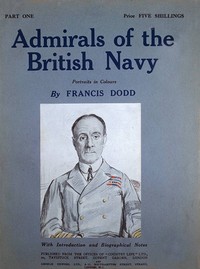
Sitting with Frank Mixson's weary memoirs, I recalled how his days were measured by small loyalties—shared rations, a steadying word. There's an old volume beyond that explores the same quiet devotion, though on a grander stage. Two histories, different seas, one human truth: Admirals of the British Navy Portraits in Colours with Introductory and Biographical Notes — Context and Discussion holds men equally bound to duty's slow tide. Both whisper of endurance.
There are no reviews for this eBook.
There are no comments for this eBook.
Reader reflection
Take a moment to reflect on this book
Create a short personal record of your experience with this book.
Your progress
0
/
10
2
How much did you enjoy the reading experience?
3
Would you recommend this book to another reader?
4
What was the reading difficulty like?
5
How valuable was this book for your own interests?
6
What was its emotional impact?
7
Did you relate to its people, ideas, or situations?
8
Is this a title worth rereading?
9
What changed or sharpened your thinking?
10