1

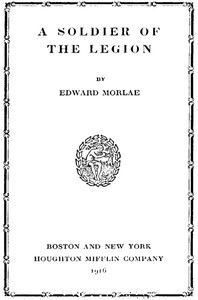
A Soldier of the Legion — Text and Context
(0 User reviews)
1069
Project Gutenberg
2014
Not confirmed
World War, 1914-1918 -- Personal narratives; France. Armée. Légion étrangère
Readers of public-domain and historical texts
Project Gutenberg digital edition
en
Edition facts
Words
21,306
Reading time
93 min
Text sections
3
The source record for A Soldier of the Legion — Text and Context measures this digital text at 21,306 words, 1 hr 33 min estimated reading time, and 3 detected text sections.
The text analysis averages about 17.9 words per sentence, while the detected sections provide another way to judge how the source is divided.
Project Gutenberg metadata also associates the work with “World War, 1914-1918 -- Personal narratives,” connecting these edition facts with the source record’s subject description.
Source:
Project Gutenberg record #46651
Edward Morlae's memoir of service in the French Foreign Legion during WWI, notable for its blunt, unsentimental prose and precise depiction of trench routine, from soup distribution to the aftermath of shelling.
Editorial Edition Score
4.6/5
★★★★★
★★★★★
Calculated from edition completeness, EPUB availability, text structure and catalogue metadata. Not a user rating.
How this score is calculated
- Description quality20 pts
- Title & short description10 pts
- Source metadata20 pts
- Text length15 pts
- Chapters / structure15 pts
- EPUB file integrity20 pts
Total of 100 points, scaled to a 2.5-5.0 range. Editions with an empty description or a missing EPUB file are not scored.
Edition quality
Public-domain source text
Read the source text
The source text is kept in the dedicated reader, separate from this catalogue record and its commentary.
Edward Morlae’s account of his time in the French Foreign Legion during the First World War is distinguished by a matter-of-fact tone that treats extreme violence as part of the daily schedule. In the excerpt from the third day of a battle, he records the delivery of soup, the death of friends, and the construction of makeshift shelters with the same flat, unadorned syntax. The narrative does not pause to moralize; instead, it lets the sequence of events—eating, walking, finding corpses—speak for itself. This refusal to heighten or sentimentalize the material gives the prose a documentary quality, as if the writer is simply noting what happened next.
Precise Diction and Understatement
Morlae’s word choices consistently avoid grand rhetoric. When he discovers his friend Sergeant Velte dead, he writes: “All three were dead, torn to pieces by one shell shortly after we had passed them in the morning.” The phrase “torn to pieces” is stark but not lurid; it is followed immediately by a report of another officer’s wounding, introduced with “Hard luck for Sweeny!” That casual exclamation—more typical of a sports field than a battlefield—underscores the narrator’s effort to maintain a stoic, almost offhand demeanor. Similarly, when his own pack is destroyed, he notes he felt “uncomfortably handicapped,” a mild term for a life-threatening situation. This understatement is a deliberate stylistic choice, not a failure of feeling; it mirrors the code of the Legion, where complaint is pointless and action is all.
Dialogue and Reported Speech
Direct dialogue is sparse in the excerpts, but reported speech carries key information. The trench telephone sergeants relay news: “The Germans are penned in on three sides and are prevented from retreating by our artillery.” The phrasing is clipped, tactical, stripped of emotion. When Morlae asks permission to walk along the trench, the captain “granted” it—a single word that signals the rigid hierarchy. The preface, written by an editor, captures Morlae’s own speaking voice in a single line: “I’m told this is the highest-toned office in the United States.” That ingratiating, slightly cocky remark reveals a man who uses humor to navigate unfamiliar social terrain, just as he uses understatement to navigate combat. The contrast between the editor’s polished prose and Morlae’s bluntness in the body of the text is itself a feature of the work.
Structure: The Rhythm of Routine
The narrative is organized around the clock, not around dramatic peaks. Morlae notes the time of each event: “At 10 a.m. we sent three men… for the soup”; “At four o’clock sentries were posted and everybody fell asleep.” The battle proceeds in a cycle of eating, digging, waiting, and walking. Even the discovery of dead comrades is inserted into this schedule without breaking the rhythm. The description of building a shelter—hooking a tent-sheet, pushing cartridges through buttonholes—is given the same weight as the report of machine-gun fire. This structure implies that survival depends on attending to small, repetitive tasks. The reader is not invited to feel awe or horror at the scale of the fighting; instead, the text insists on the mundane labor that underlies it.
Setting and Sensory Detail
The physical environment is rendered through functional, not picturesque, details. Trenches are “too crowded for comfort”; the ground is marked by “shell-holes”; a “steady rain” falls. When Morlae describes the German feu de barrage, he translates it parenthetically as “a screen of fire,” then explains its tactical purpose: “prohibiting any idea of sending reinforcements.” The setting is always tied to action or obstacle. The only moment approaching sensory richness is the description of the men cooking extra soup from “Erbsenwurst they had found on dead Germans.” That detail—the reuse of enemy rations—is both practical and macabre, but Morlae does not comment on its grimness. He simply records it as part of the day’s work. The landscape is never romanticized; it is a space to be dug, traversed, and survived.
Readers should approach A Soldier of the Legion as a record of how one man processed continuous danger through a lens of routine and restraint. The memoir does not explain the war’s causes or debate its conduct; it shows, in narrow focus, what it meant to be a non-commissioned officer responsible for a section of men. The gaps in the text—what Morlae chooses not to describe—are as telling as what he includes. Pay attention to what is omitted: no reflections on patriotism, no condemnation of the enemy, no extended grief. That silence is part of the story.
This book’s blunt grip on soup-line routine took me back to my grandfather’s shed, where I first found The Civil War Through the Camera — Story, Setting & Ideas. The same odd stillness after chaos—how dust settles on a canteen, and that’s all. Reading Morlae, I felt that familiar ache: war’s ordinary weight, remembered quietly.
There are no reviews for this eBook.
There are no comments for this eBook.
Reader reflection
What did you think of this book?
Answer a few questions and save a private reflection on this device.
Your progress
0
/
10
2
Was reading this book enjoyable?
3
How likely are you to recommend this book?
4
How much effort did this book require?
5
Which aspect of the book did you value most?
6
How clearly were the main ideas presented?
7
How did the pace of the book feel?
8
Would you like to discuss this book with someone?
9
What is the main idea you are taking away?
10