1

Bombers' Training, and Application of Same in Trench Warfare — Edition Insights
(0 User reviews)
2131
Project Gutenberg
2019
Not confirmed
Intrenchments
Readers of public-domain and historical texts
Project Gutenberg digital edition
en
Edition facts
Words
15,541
Reading time
68 min
Text sections
13
The catalog record for Bombers' Training, and Application of Same in Trench Warfare — Edition Insights provides practical reading context through 15,541 words, 1 hr 8 min estimated reading time, and 13 detected text sections.
The text analysis averages about 18.1 words per sentence, while the detected sections provide another way to judge how the source is divided.
Project Gutenberg metadata also associates the work with “Intrenchments,” connecting these edition facts with the source record’s subject description.
Source:
Project Gutenberg record #58895
A 1916 training manual for Canadian infantry bombers, detailing explosives handling, throwing technique, trench construction, and attack tactics through seven lectures and a six-day syllabus.
Editorial Edition Score
4.6/5
★★★★★
★★★★★
Calculated from edition completeness, EPUB availability, text structure and catalogue metadata. Not a user rating.
How this score is calculated
- Description quality20 pts
- Title & short description10 pts
- Source metadata20 pts
- Text length15 pts
- Chapters / structure15 pts
- EPUB file integrity20 pts
Total of 100 points, scaled to a 2.5-5.0 range. Editions with an empty description or a missing EPUB file are not scored.
Edition quality
Public-domain source text
Read the source text
The source text is kept in the dedicated reader, separate from this catalogue record and its commentary.
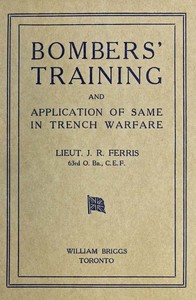
Lieutenant J. R. Ferris’s 1916 manual, written for the 63rd O. Bn., C.E.F., opens by stating its purpose: a guide for officers and N.C.O.s training bombers. The preface notes that prior to the adoption of bomb fighting on the Western front, infantry had little need for explosives knowledge—that was engineers’ work. Now, with bombs and grenades in use, infantry must learn handling, shipping, storage, and properties of explosives. The manual’s seven lectures and six-day syllabus reflect this urgent shift.
From Engineers to Infantry: A Shift in Explosives Training
The preface establishes a key historical context: before the war, explosives were the domain of Engineers, as seen in the Manual of Field Engineering, 1911. Ferris argues that manual, written before the bomb method, does not fully apply to current infantry needs. This work fills that gap, providing instruction on handling, shipping, and storage to avoid accidents, and on the characteristics and properties of explosives to make the best use of them. The author acknowledges Capt. G. S. Laing and Capt. G. D. Powis for assistance, grounding the manual in practical military experience.
Throwing Position and the Danger of Eagerness
In the excerpt on throwing, Ferris describes the correct position: feet spread, shoulder opposite throwing hand facing the target, bomb brought upward with a straight arm and circular motion, released when the hand is above the head. He notes that in a narrow trench, men cannot move from a standing position, so practices must enforce that stance. A telling observation: “men in their eagerness to get rid of the live bomb lose sight of the main object for which they are being trained, namely, accuracy and range.” This caution against haste under pressure is a recurring theme.
Sandbags, Tools, and Trench Comforts
Ferris devotes attention to practical trench skills. Sandbags are passed between legs, keeping heads down from rifle and machine-gun fire. Men practice building blockades and breastworks; in absence of sandbags, grain or flour sacks may be used. Digging and cutting tools are practiced in standing, kneeling, and lying positions. Reconstruction work uses dummy trenches wrecked for practice with earth, sandbags, sods, timber, brushwood, bale wire, and old packing cases. Means of egress from trenches—cutting steps, reinforcing with board, providing handhold—are taught so the whole line can go forward together. Even “trench comforts” are addressed: tight clothing at neck and waist to prevent falling earth, change of socks, and a supply of smokes.
Passing Orders and the Six-Day Syllabus
The manual emphasizes passing orders and information correctly by word of mouth, with a sender at one end and a receiver at the other keeping a record. This is practised during trench exercises. The syllabus for a six-day bombers’ school is shown on page 37, with a list of material and equipment for a class of 50 on page 38. The lectures cover explosives (working knowledge, classification, characteristics), types of rifle and hand grenades, bombers’ training in two parts, frontal attack, consolidating ground gained, and enfilade attack. The structure moves from theory to application, with the syllabus providing a concrete schedule for instructors.
Ferris’s manual is a practical, period-specific document that reveals the rapid adaptation of infantry training to trench warfare. Readers should note the emphasis on safety, accuracy, and the integration of multiple skills—from explosives handling to trench construction. The excerpts show a concern for both effectiveness and survival, with repeated warnings against haste and reminders to maintain cover. This is not a general treatise but a direct response to the conditions of 1916.
Flipping through that old Canadian bombing manual, I found myself thinking not of trenches, but of structures underneath—how every throw depends on unseen support, every tactic on a network of quiet bonds. It reminded me, strangely, of The Web — Text and Context, where meaning hides in the threads between words. Perhaps all instruction, like memory, is just context held together.
There are no reviews for this eBook.
There are no comments for this eBook.
Reader reflection
Your personal reading reflection
Build a private reading journal entry for this title.
Your progress
0
/
10
2
What was your overall reaction to the book?
3
Is this a title you would suggest to others?
4
Did the language feel accessible?
5
Did any part of the book stay with you emotionally?
6
Could you see yourself revisiting this book?
7
Did the book meet your expectations?
8
Would you start a conversation about this book?
9
What is the main idea you are taking away?
10