1

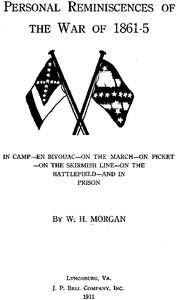
Personal Reminiscences of the War of 1861-5 In Camp—en Bivouac—on the March—on Picket—on the Skirmish Line—on the Battlefield—and in Prison — A Reader’s Guide
(0 User reviews)
1678
Project Gutenberg
2016
Not confirmed
United States -- History -- Civil War, 1861-1865 -- Regimental histories; United States -- History -- Civil War, 1861-1865 -- Personal narratives, Confederate; Confederate States of America. Army. Virginia Infantry Regiment, 11th; Morgan, W. H. (William Henry), 1836-
Readers of public-domain and historical texts
Project Gutenberg digital edition
en
Edition facts
Words
66,141
Reading time
288 min
Text sections
29
For Personal Reminiscences of the War of 1861-5 In Camp—en Bivouac—on the March—on Picket—on the Skirmish Line—on the Battlefield—and in Prison — A Reader’s Guide, the stored edition analysis reports 66,141 words, 4 hr 48 min estimated reading time, and 29 detected text sections.
The text analysis averages about 20.2 words per sentence, while the detected sections provide another way to judge how the source is divided.
Project Gutenberg metadata also associates the work with “United States -- History -- Civil War, 1861-1865 -- Regimental histories,” connecting these edition facts with the source record’s subject description.
Source:
Project Gutenberg record #51838
Morgan's memoir uses a subtitle that maps the soldier's experience through six distinct phases—camp, bivouac, march, picket, skirmish line, battlefield, and prison—and the narrative follows that structure, moving between intimate domestic loss and the impersonal machinery of war.
Editorial Edition Score
4.8/5
★★★★★
★★★★★
Calculated from edition completeness, EPUB availability, text structure and catalogue metadata. Not a user rating.
How this score is calculated
- Description quality20 pts
- Title & short description10 pts
- Source metadata20 pts
- Text length15 pts
- Chapters / structure15 pts
- EPUB file integrity20 pts
Total of 100 points, scaled to a 2.5-5.0 range. Editions with an empty description or a missing EPUB file are not scored.
Edition quality
Public-domain source text
Read the source text
The source text is kept in the dedicated reader, separate from this catalogue record and its commentary.
W. H. Morgan’s subtitle—In Camp—en Bivouac—on the March—on Picket—on the Skirmish Line—on the Battlefield—and in Prison—is not merely decorative; it serves as the book’s organizing principle. Each chapter typically focuses on one of these settings, and the narrative shifts abruptly between them, mirroring the dislocations of a soldier’s life. Morgan rarely lingers in reflection; instead, he moves from a snow-covered bivouac where men slept unaware of the white blanket, to a hurried departure that leaves fresh herring uneaten in the woods, to the sickening spectacle of three deserters shot before the assembled regiments. These swift transitions, rendered in plain, unadorned prose, give the memoir its particular texture.
The Subtitle as Structural Blueprint
Morgan’s subtitle lists six settings, and the table of contents confirms that each chapter is anchored to one of them. The opening chapters track the company’s organization and march to Manassas; later chapters follow movements to Richmond, North Carolina, and back to Virginia. The narrative rarely strays from the immediate physical location—camp, bivouac, march, picket, skirmish line, battlefield, or prison. This structure gives the memoir a documentary quality: the reader experiences the war as a sequence of places and routines rather than a continuous story. Morgan himself notes in the preface that he aimed to relate events “just as they occurred,” and the subtitle’s segmentation reinforces that claim.
Recurring Images of Cover and Exposure
Throughout the excerpts, Morgan returns to images of covering and uncovering. Men sleep under blankets while snow falls, “unconscious of the additional cover spread over them.” Herring are covered in leaves for breakfast but left behind. The deserters are bound to stakes in a hollow square, exposed to the firing detail. Even the death of Morgan’s son, Dixie, is described in terms of laying him “to rest in the old family graveyard.” These moments of protection and vulnerability recur across different settings—bivouac, march, execution ground—and create a quiet pattern: the soldier is alternately sheltered by circumstance and stripped of that shelter.
Movement Between Domestic and Military Spaces
Morgan’s narrative moves abruptly between the home front and the army. In one passage, he receives a detail to go home for supplies, rejoices in being with “the loved ones,” then watches his infant son die of acute indigestion. The day after the burial, “the rules of war being inexorable,” he returns to the army. This juxtaposition is not analyzed; it is simply reported. Later, while marching through Southampton County, Morgan’s mess buys fresh herring, eats some, and covers the rest in leaves—only to be roused at daybreak and leave the fish behind. The domestic act of saving food for breakfast is cut short by military orders. These contrasts are presented without commentary, but their accumulation gives the memoir an undercurrent of loss that is never directly named.
The Execution Scene as a Set Piece
One of the most vivid passages in the excerpts describes the shooting of three deserters near Goldsboro, North Carolina. Morgan notes the formation: regiments drawn up around the victims, who are “bound to stakes in hollow square formation, one side of the square being open.” A detail of eighteen men fires, half with balls, half without. Morgan emphasizes that none of the executed men belonged to his own Eleventh Regiment, and he calls the event “a sickening spectacle, never witnessed before or afterwards.” The scene is rendered with precise visual detail—the open side of the square, the mixed loads—and stands out as a rare moment of explicit moral weight in a narrative that otherwise reports events without judgment.
Morgan’s memoir rewards a reader who attends to its structure and recurring details. The subtitle is a reliable guide: each chapter is keyed to a specific setting, and the narrative moves between them with little transition. Pay attention to the small, concrete objects—herring, snow, a child’s grave, the stakes of an execution ground—that appear and disappear. They are the evidence from which Morgan builds his account, and they carry more weight than any explicit commentary he might have added.
Some memoirs map a soldier’s whole interior geography, camp to prison, as Morgan does. But I’ve always found a quieter kinship with The War; "Stonewall" Jackson, His Campaigns and Battles, the Regiment as I Saw Them — Background and Themes, where the same war becomes a different creature—seen through one regiment’s eyes, less a machine and more a slow, stubborn heartbeat. Two books, one war, two distinct breaths.
There are no reviews for this eBook.
There are no comments for this eBook.
Reader reflection
Your personal reading reflection
Build a private reading journal entry for this title.
Your progress
0
/
10
2
What was your overall reaction to the book?
3
Would you pass this book on to a friend?
4
Did the language feel accessible?
5
How did the pace of the book feel?
6
Did the book offer a fresh perspective?
7
Would you read this book again?
8
How useful were the ideas in this book?
9
What is the main idea you are taking away?
10