1

The 21st Missouri Regiment Infantry Veteran Volunteers: Historical Memoranda — Text and Context
(0 User reviews)
1341
Project Gutenberg
2018
Not confirmed
United States -- History -- Civil War, 1861-1865 -- Regimental histories; Missouri -- History -- Civil War, 1861-1865 -- Regimental histories; United States. Army. Missouri Infantry Regiment, 21st (1861-1866)
Readers of public-domain and historical texts
Project Gutenberg digital edition
en
Edition facts
Words
15,027
Reading time
66 min
Text sections
9
Before opening The 21st Missouri Regiment Infantry Veteran Volunteers: Historical Memoranda — Text and Context, the edition data offers a quick orientation: 15,027 words, 1 hr 6 min estimated reading time, and 9 detected text sections.
The text analysis averages about 15.9 words per sentence, while the detected sections provide another way to judge how the source is divided.
Project Gutenberg metadata also associates the work with “United States -- History -- Civil War, 1861-1865 -- Regimental histories,” connecting these edition facts with the source record’s subject description.
Source:
Project Gutenberg record #57361
This editorial note examines the authorial choices in T. W. Holman and N. D. Starr's regimental history, focusing on its documentary diction, structural framing, and the interplay between official reports and personal recollection in the 21st Missouri's Civil War record.
Editorial Edition Score
4.6/5
★★★★★
★★★★★
Calculated from edition completeness, EPUB availability, text structure and catalogue metadata. Not a user rating.
How this score is calculated
- Description quality20 pts
- Title & short description10 pts
- Source metadata20 pts
- Text length15 pts
- Chapters / structure15 pts
- EPUB file integrity20 pts
Total of 100 points, scaled to a 2.5-5.0 range. Editions with an empty description or a missing EPUB file are not scored.
Edition quality
Public-domain source text
Read the source text
The source text is kept in the dedicated reader, separate from this catalogue record and its commentary.
The compilers of this regimental history, T. W. Holman and N. D. Starr, were themselves veterans of the 21st Missouri, and their authorial choices reflect a dual purpose: to create a permanent record for survivors and to assert the regiment's contributions against perceived neglect. The preface reveals that the work originated from a reunion call in 1888, and the text retains the flavor of a committee report—formal, declarative, and driven by chronology. Yet within this structure, the compilers occasionally shift into a more personal register, as when they describe the 16th Corps' appearance as “most abject” and quote General Banks’ alleged epithet, “Smith’s Guerrillas.” This blend of official summary and pointed commentary gives the memoranda a distinctive voice, one that balances documentation with the desire to set the record straight.
Documentary Diction and the Voice of the Compiler
The language of the Historical Memoranda is predominantly that of a military after-action report: precise, impersonal, and laden with numbers. The summary of the Red River Campaign, for instance, lists battles and skirmishes in a terse, bullet-like format, and the narrative often quantifies losses and captures with exact figures (“about five hundred killed and wounded,” “three hundred and fifty prisoners”). This documentary style establishes credibility and echoes the official records the compilers likely consulted. However, the compilers’ own voice emerges in evaluative phrases. The campaign is called “a failure and as barren of results … as it would have been if made to the North Pole”—a simile that is both vivid and bitter. Such moments reveal the compilers’ frustration with leadership, particularly General Banks, whom they accuse of incompetence and bias against the 16th Corps. The diction thus oscillates between neutral report and pointed critique, reflecting the veterans’ desire to correct the historical record.
Structural Framing: From Reunion to Regimental History
The book’s structure is shaped by its origin as a reunion project. The preface explains that Holman published a call for a meeting in 1888, leading to the formation of an association and, eventually, the appointment of historians. This backstory is not merely prefatory; it frames the entire work as a collective endeavor. The narrative proceeds chronologically from the “Call to Arms” through campaigns, but the compilers periodically insert summary sections, such as “Comments on the Seventy Days’ Campaign,” that step back from strict chronology to offer evaluation. This structural choice—alternating between narrative and commentary—allows the compilers to fulfill their mandate to “compile and perpetuate the history” while also advocating for the regiment’s reputation. The inclusion of a detailed list of battles and a summary of losses further reinforces the documentary purpose, but the evaluative passages ensure that the memoranda is not a dry roster but a partisan account.
Recurring Details: The Regiment’s Hardships and Neglect
A recurring motif in the excerpts is the suffering of the 21st Missouri and the 16th Corps, often attributed to poor leadership. The compilers emphasize that the men were “unprovided with clothing and shoes” and presented “a most abject appearance.” They contrast the regiment’s sacrifices with the perceived favoritism shown to other corps, noting that the 16th Corps was “always placed in the most exposed positions.” This theme of neglect is reinforced by the compilers’ insistence on the regiment’s gallantry, as when they record that Major Fyan personally thanked them for their conduct at Pleasant Hill. The attention to such details—the lack of supplies, the unfair assignments, the belated recognition—suggests that the memoranda serves not only as history but as a corrective to official accounts that might have overlooked the regiment’s role. The compilers’ choice to include these grievances reveals their investment in shaping the regiment’s legacy.
The Interplay of Official Record and Personal Recollection
While the Historical Memoranda relies on official-sounding language, it is fundamentally a product of memory and reunion. The compilers were participants in the events they describe, and their authorial choices reflect a tension between objective record and subjective experience. For example, the narrative of the Red River Campaign includes precise dates and troop movements, yet it also conveys the emotional weight of the campaign through phrases like “tired and bleeding troops.” The compilers do not fabricate dialogue, but they do report a remark attributed to General Banks (“Smith’s Guerrillas”) that carries a sting of resentment. This blend of factual recitation and personal commentary is characteristic of veteran-authored histories. The compilers are not disinterested chroniclers; they are advocates for their comrades. The resulting text is both a reference work and a testament, a combination that gives the memoranda its particular texture.
Readers approaching this memoranda should attend to the interplay between its documentary surface and its undercurrent of advocacy. The compilers’ choices—in diction, structure, and emphasis—reveal a work that is as much about vindication as about record-keeping. The text rewards those who read between the numbers, noting where the official tone gives way to pointed commentary. For a fuller understanding, consider comparing the compilers’ account with other regimental histories or official reports from the same campaigns; such a comparison will illuminate the particular perspective that shapes this volume.
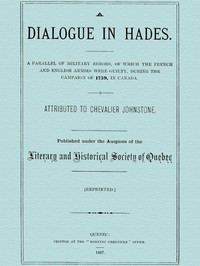
That afternoon, the rain kept time against the window while I traced the 21st Missouri’s quiet blending of orders and memory. Later, that same unease—how war reports tidy themselves—led me, without planning, to A Dialogue in Hades A Parallel of Military Errors, of Which the French and English Armies Were Guilty, During the Campaign of 1759, in Canada — Themes and Context. The voices there felt familiar, almost like old acquaintances.
There are no reviews for this eBook.
There are no comments for this eBook.
Reader reflection
How did this book work for you?
Your answers remain private and are stored only in this browser.
Your progress
0
/
10
2
How did the book work for you overall?
3
Would you encourage someone else to read it?
4
What was the reading difficulty like?
5
Did this book create an emotional response?
6
How did the pace of the book feel?
7
What was the strongest part of the book?
8
How well did it match your expectations?
9
What changed or sharpened your thinking?
10