1

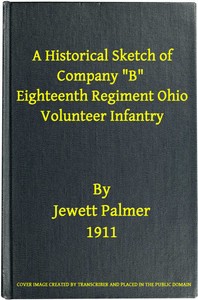
A Historical Sketch of Company "B," Eighteenth Regiment Ohio Volunteer Infantry Three Months Service — A Closer Reading
(0 User reviews)
660
Project Gutenberg
2019
Not confirmed
United States -- History -- Civil War, 1861-1865 -- Regimental histories; United States. Army. Ohio Infantry Regiment, 18th (1861-1864). Company B; Ohio -- History -- Civil War, 1861-1865
Readers of public-domain and historical texts
Project Gutenberg digital edition
en
Edition facts
Words
11,831
Reading time
52 min
Text sections
9
A Historical Sketch of Company "B," Eighteenth Regiment Ohio Volunteer Infantry Three Months Service — A Closer Reading can be approached with a clearer sense of reading commitment from its source measurements: 11,831 words, 52 min estimated reading time, and 9 detected text sections.
The text analysis averages about 13.4 words per sentence, while the detected sections provide another way to judge how the source is divided.
Project Gutenberg metadata also associates the work with “United States -- History -- Civil War, 1861-1865 -- Regimental histories,” connecting these edition facts with the source record’s subject description.
Source:
Project Gutenberg record #60243
Jewett Palmer's 1911 regimental history of Company B, 18th Ohio Volunteer Infantry, written fifty years after enlistment, combines a narrative of the company's three-month service with a detailed descriptive roll tracing each soldier's later war record.
Editorial Edition Score
4.5/5
★★★★★
★★★★★
Calculated from edition completeness, EPUB availability, text structure and catalogue metadata. Not a user rating.
How this score is calculated
- Description quality20 pts
- Title & short description10 pts
- Source metadata20 pts
- Text length15 pts
- Chapters / structure15 pts
- EPUB file integrity20 pts
Total of 100 points, scaled to a 2.5-5.0 range. Editions with an empty description or a missing EPUB file are not scored.
Edition quality
Public-domain source text
Read the source text
The source text is kept in the dedicated reader, separate from this catalogue record and its commentary.
Jewett Palmer wrote this history exactly fifty years after enlisting on April 22, 1861, a temporal distance that shapes the work's dual perspective: the immediacy of a participant's memory and the retrospective ordering of a half-century later. The opening pages recount the company's formation in Marietta, Ohio, with precise dates—enrollment from April 15 to 22, acceptance by Governor Dennison on April 17—and vivid public ceremonies: a Sunday sermon by Rev. Thomas Wickes, presentation of pocket Testaments by the Washington County Bible Society, and a flag presentation by Melvin Clarke before a crowd of 3,000. Palmer then quotes the Marietta Intelligencer's description of the departure, embedding a contemporary newspaper account within his own narrative.
A Narrative Framed by Ceremony and Documentation
The opening excerpts establish a pattern of alternating between personal recollection and documentary evidence. Palmer describes the company's embarkation on the steamer Lizzie Martin and the emotional leave-taking, but immediately follows with a newspaper clipping. This technique recurs throughout: the author does not rely solely on memory but anchors his account in published sources, official records, and the testimony of others. The reader should note how Palmer weaves these materials together, creating a history that is both intimate and verifiable. The narrative voice is that of a veteran writing for his comrades, assuming shared knowledge of places and persons, yet the inclusion of external references suggests an awareness of a broader audience.
The Descriptive Roll as Collective Biography
The longest section of the excerpts is the Descriptive Roll, a roster of each company member with annotations of their subsequent service. For example, William Holden became a quartermaster in the 2nd West Virginia Cavalry; Henry Henning died in a Washington, D.C. hospital; and Thomas Fisher was severely wounded at Antietam. The roll is not merely a list but a condensed biography of the company's dispersal into other regiments and batteries—many joined the 1st West Virginia Light Artillery. This section transforms the three-month company into a node in a larger network of Civil War service. Readers should examine the roll for patterns: which men reentered service, which were promoted, which died. The roll gives the lie to the idea that the three-month term was a brief, isolated episode.
The Three-Month Term as a Point of Departure
Palmer's title emphasizes the three-month service, yet the Descriptive Roll shows that for most men, this was only the beginning. The company mustered in April 1861, but the roll tracks individuals through 1865 and beyond. This structural choice—a short narrative followed by a long appendix of later service—shapes the reader's understanding of the company's significance. The three-month term is not the whole story but a foundation. Palmer, writing in 1911, could trace the full arc of his comrades' war experiences. The reader should approach the initial narrative as a prelude, with the roll providing the denouement for each soldier. The history thus becomes a memorial not just of a single unit but of the men who passed through it.
Voice, Tone, and the Passage of Time
Palmer's prose is direct and unadorned, typical of regimental histories, but it carries the weight of fifty years of retrospection. He writes as a participant, using first-person plural ('we left Marietta'), yet he also adopts the stance of a historian, quoting newspapers and official documents. The tone is earnest and respectful, without sentimentality. The reader should attend to the moments where Palmer's personal voice breaks through—for instance, in the description of the flag presentation and the company's pledge. These passages reveal the emotional core of the narrative: the pride and solemnity of young men going to war. The juxtaposition of this youthful enthusiasm with the roll's stark notations of death and disability creates a quiet elegy. Palmer does not moralize; he lets the facts speak.
Because Palmer wrote this sketch for his fellow veterans, he assumes familiarity with local geography and military terminology. A reader new to Civil War history may wish to consult a map of western Virginia and a glossary of rank abbreviations. The Descriptive Roll rewards careful study: each line is a story. The narrative itself is brief—the three-month service occupies only a few pages—so the roll provides the real substance. Approach this work as a memorial volume, a record of names and fates, and let the spare prose speak for itself.
I kept thinking about how Palmer wrote those soldiers fifty years later, as if still carrying their footsteps through his sentences. That same quiet ache of remembering people who had whole lives after the war—I found it again in Personal record of the Thirteenth Regiment, Tennessee Infantry — Reading Notes. It’s less a history than a long exhale, and it stayed with me.
There are no reviews for this eBook.
There are no comments for this eBook.
Reader reflection
What did you think of this book?
Answer a few questions and save a private reflection on this device.
Your progress
0
/
10
2
What was your overall reaction to the book?
3
Would you recommend this book to another reader?
4
What was the reading difficulty like?
5
Which element worked best for you?
6
How would you describe its reading pace?
7
Did this book create an emotional response?
8
How understandable was the text?
9
Which lesson or insight stayed with you?
10