1

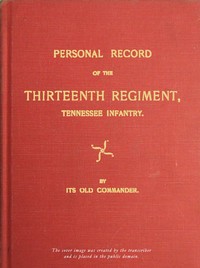
Personal record of the Thirteenth Regiment, Tennessee Infantry — Reading Notes
(0 User reviews)
2375
Project Gutenberg
2015
Not confirmed
United States -- History -- Civil War, 1861-1865 -- Regimental histories; Confederate States of America. Army. Tennessee Infantry Regiment, 13th
Readers of public-domain and historical texts
Project Gutenberg digital edition
en
Edition facts
Words
24,998
Reading time
109 min
Text sections
3
Before opening Personal record of the Thirteenth Regiment, Tennessee Infantry — Reading Notes, the edition data offers a quick orientation: 24,998 words, 1 hr 49 min estimated reading time, and 3 detected text sections.
The text analysis averages about 14.2 words per sentence, while the detected sections provide another way to judge how the source is divided.
Project Gutenberg metadata also associates the work with “United States -- History -- Civil War, 1861-1865 -- Regimental histories,” connecting these edition facts with the source record’s subject description.
Source:
Project Gutenberg record #49898
A regimental history by its commander, combining a narrative of the 13th Tennessee Infantry's campaigns with extensive rosters documenting officers, enlisted men, and casualties from Shiloh to Atlanta.
Editorial Edition Score
4.6/5
★★★★★
★★★★★
Calculated from edition completeness, EPUB availability, text structure and catalogue metadata. Not a user rating.
How this score is calculated
- Description quality20 pts
- Title & short description10 pts
- Source metadata20 pts
- Text length15 pts
- Chapters / structure15 pts
- EPUB file integrity20 pts
Total of 100 points, scaled to a 2.5-5.0 range. Editions with an empty description or a missing EPUB file are not scored.
Edition quality
Public-domain source text
Read the source text
The source text is kept in the dedicated reader, separate from this catalogue record and its commentary.
Alfred J. Vaughan, who commanded the 13th Tennessee Infantry, compiled this record in 1897 as both a personal memoir and a unit history. The book opens with a dedication to the mothers and wives of Confederate soldiers, then proceeds through a preface, a brief regimental narrative, and an extensive series of company rosters. Vaughan’s preface explicitly frames the work as a memorial: he writes that he has “lived over again the days when the boom of cannon, the rattle of musketry and the old rebel yell were familiar sounds.” The rosters, which make up the bulk of the text, list each man’s fate—killed at Shiloh, died in service, wounded, or survived the war—offering a granular record of the regiment’s human cost.
A Commander’s Dual Purpose
Vaughan’s preface reveals two intertwined aims: to preserve the “fair fame” of his comrades and to affirm postwar loyalty. He insists that the men who “wore the gray” accepted their parole “in sorrow but not in malice or hate,” and that they are now “faithful citizens of the United States.” This reconciliationist tone is paired with a clear pride in the regiment’s Confederate service. The narrative portion is brief—only a few pages—and focuses on the regiment’s organization in June 1861 as part of Cheatham’s Division. Vaughan describes the men as “the flower of the South,” fresh from “the best institutions,” but the rosters that follow undercut any romanticism with stark entries: “Killed at Shiloh,” “Missing at Missionary Ridge,” “Died in service.”
Rosters as the Core Record
The company rosters occupy the majority of the text and are the book’s most distinctive feature. Each company is listed alphabetically by surname, with brief annotations: rank at organization, promotions, wounds, and date or place of death. For example, Company E includes entries such as “Bull, D. C. Killed at Shiloh” and “Fuiks, Morris. Missing at Missionary Ridge; supposed to have been killed.” Some entries note postwar survival: “Dyer, B. L. … died since the war.” Vaughan also includes a section titled “Faithful Colored Servants,” though the excerpts do not reveal its contents. The rosters transform the book from a simple narrative into a genealogical resource, documenting individual soldiers across multiple theaters—Belmont, Shiloh, Murfreesboro, Chickamauga, Atlanta, and Franklin.
Silences and Selectivity
The excerpts leave gaps that a reader should note. Vaughan’s narrative portion is not fully reproduced here; the rosters dominate the sample. The appendix mentions a “Famous Snowball Battle,” but no details are given. The book’s catalog subjects classify it under “United States – History – Civil War, 1861-1865 – Regimental histories” and “Confederate States of America. Army. Tennessee Infantry Regiment, 13th,” which accurately describe its content. However, the excerpts show that the work is less a continuous battle history than a compilation of names and fates. Vaughan’s voice appears mainly in the preface and dedication; the rosters are terse and administrative. Readers seeking a full campaign narrative will need to supplement this record with other sources.
This edition reproduces Vaughan’s original 1897 text, including the rosters that form its backbone. Readers interested in the 13th Tennessee’s movements should note that the narrative sections are sparse; the rosters, however, offer a detailed accounting of the regiment’s composition and losses. The appendix on the “Snowball Battle” hints at a lighter episode, but its content is not included in the excerpts. Approach the book as a memorial document rather than a tactical history, and use the rosters as a starting point for genealogical or unit-level research.
That regimental history stayed with me—not for the battle maps, but for the quiet way it listed every name, each one a person who once breathed. It made me think of another kind of record, where a correspondent’s voice carries the same weight of witness. Full Speed Ahead: Tales from the Log of a Correspondent with Our Navy — Text and Context feels like that—less about glory, more about presence.
There are no reviews for this eBook.
There are no comments for this eBook.
Reader reflection
How did this book work for you?
Your answers remain private and are stored only in this browser.
Your progress
0
/
10
2
What was your overall reaction to the book?
3
How likely are you to recommend this book?
4
How easy was the book to follow?
5
How much did the book move you?
6
How clearly were the main ideas presented?
7
How well did it match your expectations?
8
Would you start a conversation about this book?
9
What changed or sharpened your thinking?
10