1

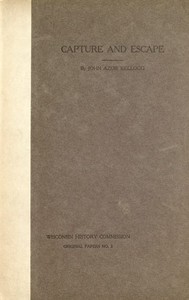
Capture and Escape: A Narrative of Army and Prison Life — A Reader’s Guide
(0 User reviews)
508
Project Gutenberg
2016
Not confirmed
United States -- History -- Civil War, 1861-1865 -- Prisoners and prisons; United States -- History -- Civil War, 1861-1865 -- Personal narratives
Readers of public-domain and historical texts
Project Gutenberg digital edition
en
Edition facts
Words
42,311
Reading time
184 min
Text sections
5
The source record for Capture and Escape: A Narrative of Army and Prison Life — A Reader’s Guide measures this digital text at 42,311 words, 3 hr 4 min estimated reading time, and 5 detected text sections.
The text analysis averages about 18.6 words per sentence, while the detected sections provide another way to judge how the source is divided.
Project Gutenberg metadata also associates the work with “United States -- History -- Civil War, 1861-1865 -- Prisoners and prisons,” connecting these edition facts with the source record’s subject description.
Source:
Project Gutenberg record #51451
Colonel John Azor Kellogg's firsthand account of capture, imprisonment, and escape during the Civil War, with precise observations of tunnel digging, betrayals, and the constant tension between hope and despair in Confederate prisons.
Editorial Edition Score
4.7/5
★★★★★
★★★★★
Calculated from edition completeness, EPUB availability, text structure and catalogue metadata. Not a user rating.
How this score is calculated
- Description quality20 pts
- Title & short description10 pts
- Source metadata20 pts
- Text length15 pts
- Chapters / structure15 pts
- EPUB file integrity20 pts
Total of 100 points, scaled to a 2.5-5.0 range. Editions with an empty description or a missing EPUB file are not scored.
Edition quality
Public-domain source text
Read the source text
The source text is kept in the dedicated reader, separate from this catalogue record and its commentary.
Colonel John Azor Kellogg's narrative opens not with a declaration of war but with the mundane details of camp life in the Iron Brigade. The shift from routine to crisis is abrupt: a skirmish line, then capture. Kellogg's voice is direct, often understated, as he recounts the immediate transition from soldier to prisoner. The excerpts reveal a man who observes closely—the kindling of a mysterious fire in the road, the cautious advance of what turns out to be a hog—and who records the small, telling details that accumulate into a larger picture of endurance. This is not a grand strategic history but a ground-level account of what it meant to be captured, transported, and confined, with the constant, often thwarted, drive to escape.
The Mechanics of Tunneling and Betrayal
Kellogg devotes considerable attention to the practical challenges of escape, particularly tunneling. In one episode, he describes the careful process of digging a tunnel from the prison pen, only to have it discovered. The betrayal is not anonymous; Kellogg names informants among the prisoners themselves. This pattern—hope, labor, discovery, and betrayal—recurs. The narrative does not romanticize the prisoners as a unified body; instead, it shows the internal tensions, the desperation that could turn a man into an informant. The tunnels themselves become characters: fragile, precarious, and ultimately unreliable. Kellogg's descriptions of the physical labor—the cramped spaces, the disposal of dirt, the constant fear of collapse—ground the story in tangible, gritty reality.
The Unreliable Landscape: Fire, Hogs, and Missing Men
A striking passage in the excerpts involves a fire kindled in the road, which Kellogg and his companions debate at length. Is it a signal? A trap? They decide to flank it, only to be startled by a movement in the brush—which turns out to be a hog. The anticlimax is both comic and revealing: the landscape is full of false alarms and misinterpreted signs. Later, two men vanish during the night. Kellogg's search yields nothing, and the mystery of their disappearance is never fully resolved. These episodes underscore the uncertainty that pervades the narrative. The environment—roads, woods, darkness—is not neutral but actively deceptive, and Kellogg's careful, almost forensic attention to these moments highlights the psychological toll of constant vigilance.
Voice and Structure: A Soldier's Understatement
Kellogg's prose is notably restrained. He does not dwell on his own emotions; instead, he reports actions and observations. When he discovers the hog, he notes that they were 'too frightened to laugh, too relieved to be angry.' The humor is dry, almost wry. The structure of the narrative follows a chronological arc from capture to escape, but within that framework, Kellogg inserts set pieces—the tunnel, the fire, the missing men—that function as discrete, almost anecdotal, episodes. This gives the book a modular quality, where each chapter or section can stand alone as a vignette of prison life. The overall effect is cumulative: the reader experiences not a single dramatic escape but a series of attempts, setbacks, and small, hard-won victories.
Readers should approach this narrative as a document of specific, lived experience rather than a comprehensive history of Civil War prisons. Kellogg's focus is on the immediate—the texture of daily life under confinement, the mechanics of escape, the unreliability of both comrades and the environment. The book rewards attention to small details: the way a fire in the road can derail a plan, the weight of a missing compass, the shape of a hog in the dark. These are the elements that make the account feel authentic and, at times, surprisingly intimate.
I kept thinking about Kellogg’s quiet arithmetic—each tunnel inch measured against a rumor of hope. That raw tally of waiting, the betrayals disguised as kindness, it stays with you. His relentless noting of days made me wonder about the other side’s ledger. Experience of a Confederate States Prisoner Being an Ephemeris Regularly Kept by an Officer of the Confederate States Army — Reading Companion felt like sitting beside that same fire, but hearing the other man’s low, steady voice.
There are no reviews for this eBook.
There are no comments for this eBook.
Reader reflection
What did you think of this book?
Answer a few questions and save a private reflection on this device.
Your progress
0
/
10
2
How did the book work for you overall?
3
Is this a title you would suggest to others?
4
How much effort did this book require?
5
How understandable was the text?
6
How closely did the book connect with your experience?
7
Did this book create an emotional response?
8
How useful were the ideas in this book?
9
What is the main idea you are taking away?
10