1

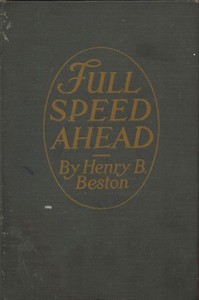
Full Speed Ahead: Tales from the Log of a Correspondent with Our Navy — Text and Context
(0 User reviews)
1617
Project Gutenberg
2019
Not confirmed
World War, 1914-1918 -- Naval operations; United States. Navy
Readers of public-domain and historical texts
Project Gutenberg digital edition
en
Edition facts
Words
48,840
Reading time
213 min
Text sections
5
For Full Speed Ahead: Tales from the Log of a Correspondent with Our Navy — Text and Context, the stored edition analysis reports 48,840 words, 3 hr 33 min estimated reading time, and 5 detected text sections.
The text analysis averages about 18.7 words per sentence, while the detected sections provide another way to judge how the source is divided.
Project Gutenberg metadata also associates the work with “World War, 1914-1918 -- Naval operations,” connecting these edition facts with the source record’s subject description.
Source:
Project Gutenberg record #60196
Henry Beston's 1919 collection of firsthand dispatches from a correspondent aboard U.S. Navy destroyers in World War I, focusing on the structure of patrol life, recurring images of the sea, and the abrupt shifts between routine and combat.
Editorial Edition Score
4.7/5
★★★★★
★★★★★
Calculated from edition completeness, EPUB availability, text structure and catalogue metadata. Not a user rating.
How this score is calculated
- Description quality20 pts
- Title & short description10 pts
- Source metadata20 pts
- Text length15 pts
- Chapters / structure15 pts
- EPUB file integrity20 pts
Total of 100 points, scaled to a 2.5-5.0 range. Editions with an empty description or a missing EPUB file are not scored.
Edition quality
Public-domain source text
Read the source text
The source text is kept in the dedicated reader, separate from this catalogue record and its commentary.
Henry Beston opens his log with a frank admission: “A destroyer is by no means a paradise of comfort.” That line sets the tone for a collection that moves between the cramped, watchful boredom of convoy duty and the sudden, violent eruptions of depth-charge attacks. Beston, a special correspondent attached to the American Navy on foreign service, structures his tales not as a continuous narrative but as a series of discrete episodes—each one a self-contained memory or interview. The result is a book that feels less like a history and more like a logbook, where the reader is dropped into the middle of a patrol, left to piece together the larger war from the small, sharp details Beston records.
The Rhythm of Waiting and Action
Beston’s accounts are built on a pattern of long stretches of monotony punctuated by moments of extreme tension. In the depth-charge episode, he describes how the crew, “not staled by months of unfruitful vigil,” acted “as swiftly as if the destruction of a submarine were matter of daily practice.” The destroyer “leaped ahead like a runner from the starting line,” and the attack unfolds in a series of precise, almost mechanical steps: the periscope sighted, the submarine submerging, the depth bombs falling “into the heart of the submarine’s swirl even as a well placed stone falls in the heart of a pool.” Beston’s prose mirrors this rhythm—calm, observational sentences give way to short, staccato phrases as the action intensifies. He notes the “thundering pound” of the explosions and the “ugly hollow crashes of tearing steel,” then lets the scene dissolve back into stillness: “the calm of the spring morning, which had been frightened away like a singing bird, returned once more to the tragic and mysterious sea.” This structural alternation between waiting and action is the book’s organizing principle.
Recurring Images: The Sea as Witness
Throughout the excerpts, Beston returns to a set of recurring images that anchor his observations. The sea itself is a constant presence, described in terms that shift with the mood of the scene. In the attack passage, the waves are “flattened, marbly,” and the submarine’s wake is “a white furrow like a kind of comet’s tail, forever widening at the end.” Later, the sea becomes “tormented” and then, after the sinking, “tragic and mysterious.” Beston also fixates on the physical details of the submarine: a “simple, most unromantic black rod rising two feet or so above the waves,” then “an immense, tapering rusty mass, wet and shining in the placid glance of the day.” The oil that streams from the hull “ran much like blood from a small deep wound.” These images—the periscope as a rod, the wake as a comet’s tail, the submarine as a wounded body—recur in different forms, giving the book a visual consistency that ties together its disparate tales.
Movement Between Scenes: From Log to Legend
Beston’s transitions between episodes are often abrupt, mirroring the way a correspondent might move from one assignment to the next. The depth-charge narrative is followed by a chapter titled “The Legend of Kelley,” which opens with a shift in tone: “Kelley, not Von Biberstein or Hans Bratwurst, is his name, Kelley spelled with an ‘e.’” Here, Beston moves from a detailed, firsthand account of combat to a piece of hearsay—a legend circulating among the destroyer crews about a German submarine captain who may or may not be an Irishman. He presents multiple versions of the story, noting that “the first destroyer officer whom you question will very possibly have never heard of him, the second will have heard the legend, the third will tell you of a radio officer, a friend of his, who received one of Kelley’s messages.” This movement from concrete experience to rumor and back again is a deliberate structural choice, one that underscores the uncertainty and fragmentation of wartime knowledge.
The Correspondent’s Gaze: Observation and Inference
Beston is careful to mark the limits of his own knowledge. In the attack scene, he writes that “they asked themselves what the submarine could possibly have been doing. Seeking a quiet place to come up to breathe, to effect repairs, to send out a hurried wireless message?” He does not claim to know the answer. Later, he speculates that “one felt that the gods had brought to pass there no careless drama, but a tragedy long meditated and skillfully prepared.” This is inference, not reportage, and Beston signals it as such. His preface acknowledges that some tales are “personal experiences,” others “written up from the records” or “set down after interviews.” The book’s structure—a series of logs, legends, and interviews—reflects this mixed methodology. The reader is never allowed to forget that what they are reading is a constructed account, filtered through the correspondent’s perspective and the limitations of his access.
Beston’s book rewards a reader willing to move slowly, to sit with the long stretches of waiting as much as the bursts of action. The tales are best approached as individual logs rather than a continuous narrative; the gaps between them are as telling as the events they describe. Pay attention to the recurring images—the sea, the periscope, the oil—and to the way Beston signals when he is reporting and when he is speculating. The book’s value lies not in a comprehensive view of the war, but in the specific, grounded observations of one correspondent who knew he was only ever seeing a part of the whole.
That rainy afternoon, Beston’s destroyers swayed between calm watches and sudden chaos, and I kept thinking how the sea held both in the same gray palm. Later, I found myself drifting toward the Civil War, wondering if infantrymen felt that identical stillness before the volley. There’s a quiet kinship in Reminiscences of the Nineteenth Massachusetts Regiment — Context and Discussion, as if the same long pause breathes between its pages.
There are no reviews for this eBook.
There are no comments for this eBook.
Reader reflection
How did this book work for you?
Your answers remain private and are stored only in this browser.
Your progress
0
/
10
2
How did the book work for you overall?
3
Would you encourage someone else to read it?
4
What was the reading difficulty like?
5
Did the book give you something worth debating?
6
Did the story or argument move comfortably?
7
Could you see yourself revisiting this book?
8
How understandable was the text?
9
What is the main idea you are taking away?
10