1

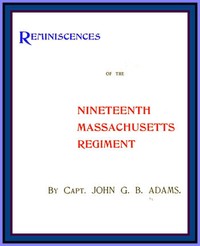
Reminiscences of the Nineteenth Massachusetts Regiment — Context and Discussion
(0 User reviews)
384
Project Gutenberg
2015
Not confirmed
United States -- History -- Civil War, 1861-1865 -- Personal narratives; United States. Army. Massachusetts Infantry Regiment, 19th (1861-1865)
Readers of public-domain and historical texts
Project Gutenberg digital edition
en
Edition facts
Words
60,996
Reading time
266 min
Text sections
8
Before opening Reminiscences of the Nineteenth Massachusetts Regiment — Context and Discussion, the edition data offers a quick orientation: 60,996 words, 4 hr 26 min estimated reading time, and 8 detected text sections.
The text analysis averages about 19.0 words per sentence, while the detected sections provide another way to judge how the source is divided.
Project Gutenberg metadata also associates the work with “United States -- History -- Civil War, 1861-1865 -- Personal narratives,” connecting these edition facts with the source record’s subject description.
Source:
Project Gutenberg record #49014
Captain John G. B. Adams recounts his service with the 19th Massachusetts Regiment, from enlistment through battles and imprisonment, using a plain-spoken, anecdotal style that emphasizes small-unit actions and the daily realities of camp and combat.
Editorial Edition Score
4.7/5
★★★★★
★★★★★
Calculated from edition completeness, EPUB availability, text structure and catalogue metadata. Not a user rating.
How this score is calculated
- Description quality20 pts
- Title & short description10 pts
- Source metadata20 pts
- Text length15 pts
- Chapters / structure15 pts
- EPUB file integrity20 pts
Total of 100 points, scaled to a 2.5-5.0 range. Editions with an empty description or a missing EPUB file are not scored.
Edition quality
Public-domain source text
Read the source text
The source text is kept in the dedicated reader, separate from this catalogue record and its commentary.
Captain John G. B. Adams opens his account with a deliberate disclaimer: he offers “a soldier’s story, told by one of the ‘boys,’” not a formal regimental history. The distinction matters. Where a historian might chart brigade movements, Adams dwells on the particular—the name of the man who picked up the fallen colors, the improvised breastwork built from fence rails, the sharpshooter who dug in with his dipper. His narrative moves from the armory in Haverhill to the trenches before Petersburg, but its real geography is the small, vivid incident that reveals how men endured.
The structure follows the regiment’s campaigns in rough chronological order, yet the emphasis falls unevenly: prison life, drawn from an imperfect diary, occupies several chapters, while some battles receive only a few paragraphs. This asymmetry is itself a clue to Adams’s priorities—not a comprehensive staff ride, but a veteran’s selective memory of what stuck.
The Color-Bearer’s Bargain
One of the most striking episodes in the narrative turns on a negotiation over the regimental colors. When Major Dunn orders Mike Scannell to keep the flag after the standard-bearer falls, Scannell refuses the promotion to corporal—too many corporals have been killed carrying colors. Only when Dunn makes him a sergeant on the spot does Scannell accept: “That is business.” The exchange, rendered in direct dialogue, reveals a practical calculus behind battlefield heroism. Adams does not sentimentalize the moment; he presents it as a transaction, a deal struck under fire. The colors themselves appear repeatedly as a physical burden and a target. Elsewhere, Adams notes that the regiment’s motto was “Follow the colors of the Nineteenth,” and his narrative tracks the flag’s handlers as closely as it tracks the commanding officers. The color-bearer’s role—part symbol, part tactical liability—becomes a recurring motif that ties together otherwise disparate actions.
The Sharpshooter’s Independent Command
A brief but memorable vignette illustrates how Adams’s narrative eye gravitates toward the improvised and the anomalous. During the stalemate at the Bloody Angle, the men spot a pile of dirt on a knoll in front of their lines, from which occasional shots emerge. Digging out, they find Alonzo W. Bartlett, a private from Andrews, Massachusetts, who has crawled out to recover the body of a fallen colonel. Pinned down, he has dug a trench with his dipper and is “fighting the war on his own hook.” His face is cut and bleeding from gravel, but he has a good rifle and plenty of ammunition and intends to hold out. Adams records the names of the men who discover him—Mark Kimball, Gus Bridges, Frank Osborne, Milt Ellsworth—as carefully as he records the names of officers killed. The episode is a self-contained story within the larger battle narrative, a reminder that the war, for Adams, consists of countless such small, autonomous actions that official reports might omit.
The Truce and the Wounded Man
Adams devotes unusual attention to the informal truce that followed four days of constant musketry at the Bloody Angle. When a white flag goes up on the rebel works, both sides cease fire and men mingle freely between the lines. Adams observes that if the soldiers had the power to settle the war, “not another shot would have been fired.” The truce lasts two days; on the third morning, a rebel stands on the works and calls out, “Keep down, Yanks, we uns are going away,” and the firing resumes. Amid the burial details, the men find one wounded soldier who has lain between the lines for four days, shot in the leg, hit by both sides, without food or water. Adams does not name him; the anonymity underscores the randomness of survival. The episode serves as a pivot between the close-quarters fighting and the larger pattern of siege warfare, and it exemplifies Adams’s habit of pausing the narrative for a single, emblematic human detail.
Prison Diary as Structural Anchor
Adams explicitly states that the prison chapters are based on an “imperfect diary” kept while he was a prisoner of war. This shift in source material alters the texture of the narrative. The earlier battle accounts, written from memory years later, are episodic and anecdotal; the prison sections, by contrast, are more compressed and date-specific, though still fragmentary. The diary’s imperfections—gaps, terse entries—become part of the story. Adams does not smooth them into a continuous memoir; he lets the raggedness stand. The result is a structural contrast between the fluid, retrospective voice of the campaign chapters and the staccato, present-tense feel of the prison record. This change in narrative method gives the second half of the book a different rhythm, one that mirrors the confinement and uncertainty of captivity. Readers attentive to form will notice that the book’s architecture enacts its subject: freedom of movement gives way to constraint, and the prose follows suit.
Adams’s Reminiscences rewards a reader who watches for the small, concrete detail—the dipper used as an entrenching tool, the sergeant’s promotion traded for carrying the colors, the truce that briefly erases the line between enemies. The book is not a systematic history, nor does it pretend to be. It is a veteran’s collection of moments that survived thirty-four years of memory, arranged not by the logic of a staff ride but by the logic of what stuck. Approach it as a series of sharply lit scenes rather than a continuous narrative, and its strengths become clear.
There’s something about Adams’s plain talk of campfires and hard marches that lingers—how the men endured not by grand ideals but by small, steady acts. Reading it, I found myself thinking of the unglamorous hands behind every war, and the quiet courage of those whose names rarely make the page. The Fleets Behind the Fleet The Work of the Merchant Seamen and Fishermen in the War — A Closer Reading feels like a companion to that same unspoken truth.
There are no reviews for this eBook.
There are no comments for this eBook.
Reader reflection
How will you remember this book?
Save your reaction, strongest insight, and memorable passage.
Your progress
0
/
10
2
How much did you enjoy the reading experience?
3
Would you pass this book on to a friend?
4
Did the language feel accessible?
5
How understandable was the text?
6
What was the strongest part of the book?
7
How distinctive were its ideas or approach?
8
Would this book work well in a reading group?
9
In one sentence, what did you learn?
10